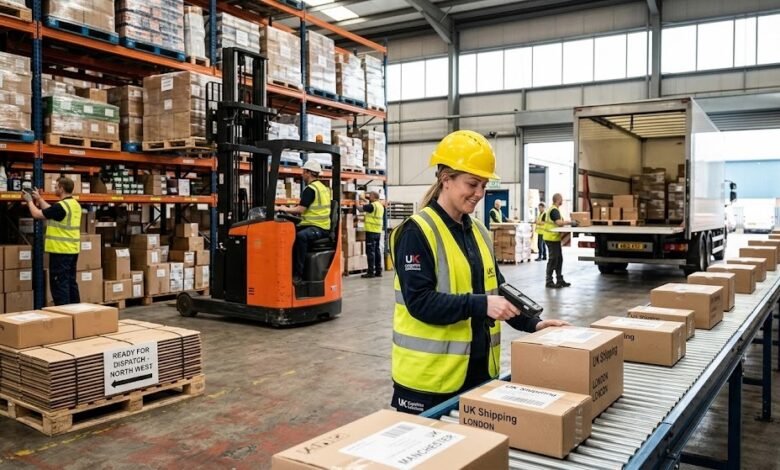
A business can have a great product, a strong website and plenty of customers, but there is still one part of the operation that can quietly cause problems: getting products from storage to the customer.
At first, logistics often feels manageable. A small team receives stock, keeps it somewhere safe, packs orders and sends them out. Then sales pick up.
Suddenly, there are hundreds of products to keep track of.
The warehouse needs more room. Orders take longer to process. Staff spend more time packing boxes. Returns start piling up. Customers begin asking where their orders are.
This is one of the situations where third-party logistics, commonly called 3PL, can make sense.
Instead of building and managing every part of the logistics operation yourself, you can hand selected responsibilities to a specialist provider. Depending on the agreement, that company may store your products, manage stock, prepare orders and arrange distribution.
For UK businesses, the attraction is not simply about having somewhere to put stock. It is about creating a logistics operation that can cope when the business changes.
Think About What Happens Between “Order Placed” and “Order Delivered”
Customers usually see only the final part of the process.
They click Buy.
Later, a parcel arrives.
Behind that simple experience, however, there can be a surprisingly long chain of activities.
Someone needs to:
- Receive the original stock
- Check quantities
- Record inventory
- Find the correct item
- Pick it from storage
- Pack it safely
- Prepare shipping information
- Hand it to a carrier
- Track the shipment
- Deal with a return if necessary
A 3PL provider can manage some or all of these steps.
That is the real idea behind third-party logistics: moving operational work away from the business and placing it with a specialist that already has the facilities, people and systems to handle it.
So, What Is 3PL?
3PL stands for third-party logistics.
The business selling the product is effectively the first party. Its customer is the second party. The external logistics company becomes the third party handling agreed parts of the supply chain.
There is no rule saying a company has to outsource everything.
One business might only need additional warehouse space.
Another might outsource picking and packing.
An ecommerce brand could choose an end-to-end arrangement covering storage, fulfilment and shipping.
Some providers also support returns, stock reporting and other supply chain activities.
So, the question is not really “Should we use 3PL?”
A better question is:
“Which parts of our logistics operation would make more sense outside the business?”
A Realistic Example
Consider a growing UK retailer selling home and lifestyle products online.
At 100 orders a month, the owners may handle fulfilment themselves.
At 500 orders, they may need a dedicated storage area.
At 2,000 orders, things become different.
Someone has to spend hours locating products. Packaging materials need replenishing. Stock counts become more important. Delivery problems take longer to investigate.
The company could respond by renting a larger warehouse and hiring more employees.
Or it could work with a 3PL provider that already has warehouse space, fulfilment staff and logistics systems.
Neither choice is automatically right.
The important thing is understanding what the business actually needs.
What Does a 3PL Provider Do With Your Stock?
The process begins before a customer places an order.
First comes receiving
Products arrive at the warehouse.
The provider records the incoming goods and checks the shipment against the expected quantities. Many modern operations use barcodes and warehouse management systems to keep inventory information organised.
Then comes storage
The products are assigned storage locations.
This might sound basic, but warehouse organisation matters. If products are difficult to locate, picking becomes slower and mistakes become more likely.
Then the order appears
A customer buys something.
The order information reaches the fulfilment system. Depending on the setup, this can happen through an integration with the business’s ecommerce or order management platform.
Someone picks the item
The warehouse team locates the product and takes it from its storage position.
If an order contains several items, all of them need to be collected correctly.
The package is prepared
The items are checked and packed.
Packaging may vary depending on the product. Fragile goods, clothing, electronics and larger items can all require different approaches.
Finally, it leaves
The completed order is handed to the appropriate delivery network.
That is when the customer usually becomes aware of the logistics process through a dispatch notification or tracking update.
The warehouse has already done most of the work.
What Can Be Included in 3PL Logistics Services?
There is quite a bit of flexibility in what businesses can outsource.
Typical 3PL logistics services can include:
- Warehousing
- Inventory control
- Pick and pack
- Order fulfilment
- Distribution
- Transport coordination
- Returns management
- Stock reporting
- Packaging
- Ecommerce integration
The exact combination depends on the provider and the business.
For example, a company that already has its own warehouse may only need help during seasonal peaks. Another business may have no warehouse at all and choose a full fulfilment arrangement.
Modern providers also use technology to give businesses greater visibility over inventory and orders. Some offer real-time stock information and integrations with sales channels.
The Warehouse Is Only Half the Story
It is easy to think of 3PL as a storage service.
It is not.
A warehouse full of products does not help much if orders cannot leave efficiently.
Transport is therefore another important part of the picture.
The right delivery method depends on the product, destination, urgency and customer requirements. A business may need standard parcel networks for everyday orders while using van delivery services for particular delivery requirements.
This is why businesses should look at the complete process rather than choosing a provider based only on warehouse space.
When Does Outsourcing Start to Make Sense?
There is no magic order number.
A company does not suddenly become a 3PL candidate after reaching 1,000 orders.
The signs are usually more practical.
You might start looking at outsourcing when:
- Your current storage area is becoming difficult to manage.
- Employees spend too much time packing orders.
- Stock records are regularly difficult to reconcile.
- Order volumes change dramatically during the year.
- Returns are taking too much internal time.
- You need additional capacity without renting another facility.
- Your business is entering new markets.
- Logistics is distracting management from core business activities.
Sometimes the warning sign is even simpler:
Your team is spending too much time moving boxes instead of running the business.
Does 3PL Automatically Save Money?
This is where businesses need to be careful.
Outsourcing does not magically make logistics cheaper.
You are paying another company to perform work that you could potentially perform yourself.
The comparison needs to include the full internal cost.
For an in-house operation, that could mean:
- Rent
- Employees
- Equipment
- Warehouse software
- Packaging
- Insurance
- Maintenance
- Training
- Administration
- Transport arrangements
A 3PL quotation should be compared against those costs, not against warehouse rent alone.
There is also a second question.
What is your team’s time worth?
If your management team is spending hours dealing with warehouse issues, that has a business cost even if it does not appear on the logistics invoice.
What About Control?
This is one of the biggest considerations when moving from in-house logistics to outsourcing.
When your own team manages the warehouse, you can walk into the facility and check what is happening.
With a 3PL partner, you depend on another organisation.
That does not necessarily mean losing control, but it does mean changing how control works.
Instead of physically managing every activity, you rely more heavily on:
- Reporting
- Stock visibility
- Service agreements
- Performance measurements
- Communication
- System integrations
A good partnership therefore needs clear expectations from the beginning.
The Questions That Matter Before You Sign
A sales meeting can make almost any logistics service sound impressive.
The better test is what happens when something goes wrong.
Ask potential providers questions such as:
What happens when stock arrives damaged?
You need to know how discrepancies are recorded and communicated.
What happens when inventory does not match your records?
Find out how stock investigations are handled.
What happens during your busiest month?
A provider that works well during a quiet period also needs enough capacity during seasonal peaks.
How quickly are orders processed?
Do not assume every provider operates to the same timetable.
How will you see your stock?
Ask whether inventory information is available through a dashboard, report or direct system integration.
What happens with returns?
Returns can create a separate workload, so understand exactly who handles them.
What costs are outside the standard price?
This question can prevent unpleasant surprises later.
Technology Can Make a Bigger Difference Than Expected
Imagine needing to email a warehouse every time you want to know how many products are available.
That would become frustrating very quickly.
Modern 3PL logistics services increasingly rely on warehouse management systems and integrations. These can connect inventory and order information between the logistics provider and the business.
The benefit is not simply convenience.
Better information can help a company answer questions such as:
- Which products are running low?
- How many orders are waiting?
- Which products are selling quickly?
- How much stock is currently stored?
- How many returns have been received?
- Are fulfilment times changing?
That information can influence purchasing, marketing and customer service decisions.
What Happens When the Business Grows?
This is where a 3PL arrangement can become particularly useful.
Imagine your normal monthly sales are steady, but Christmas brings a major increase.
Your own warehouse has a fixed amount of space.
Your staffing requirements also change.
A flexible logistics provider may be able to increase capacity during busy periods and reduce it when demand falls. Some UK providers specifically offer flexible or scalable storage and fulfilment models for changing demand.
This can be valuable for businesses that do not want to invest heavily in permanent infrastructure just to handle a few busy months.
Not Every Business Needs a 3PL Provider
There is nothing wrong with keeping logistics in-house.
If your order volume is manageable, your warehouse works well and your team has the process under control, outsourcing may add unnecessary complexity.
In-house logistics can also give businesses direct oversight of stock and fulfilment.
The decision becomes more interesting when the existing operation starts creating limitations.
That is when a business should compare both models honestly rather than assuming outsourcing is automatically better.
A Hybrid Approach Is Possible
There is also a middle ground.
A business does not have to hand over its entire supply chain.
It might keep certain products or activities in-house while outsourcing overflow storage and fulfilment.
Another company may manage its warehouse but use an external partner during seasonal demand.
This approach can provide flexibility without completely changing the existing operation.
What Should UK Businesses Look For?
A suitable provider should fit the business rather than simply offering the longest list of services.
Consider:
Location:
Where are the warehouses, and do they make sense for your customer base?
Capacity:
Can the provider cope with your current volume and future growth?
Technology:
Can its systems connect with your existing platforms?
Communication:
How quickly can you get help when something goes wrong?
Experience:
Does the provider understand your type of product and fulfilment requirements?
Pricing:
Are storage, picking, packing, returns and additional charges clearly explained?
Flexibility:
Can the arrangement change when your business changes?
These questions often reveal more than a polished sales presentation.
Final Takeaway
3PL is not simply about paying someone else to store your products.
It is a different way of organising the operational side of a business.
A company can use an external logistics partner to handle the physical work behind orders while its own team concentrates on products, customers, marketing and growth.
For one business, that might mean outsourcing the whole fulfilment operation. For another, it could mean temporary warehouse support during busy periods.
There is no universal answer.
The sensible approach is to look closely at your current logistics process. Identify where time, money or capacity are being lost. Then compare the cost and practical consequences of fixing those problems internally against working with a 3PL provider.
When the arrangement fits properly, logistics becomes less of a daily headache and more of a supporting system behind the business.
FAQs
What does 3PL stand for?
3PL means third-party logistics. It refers to outsourcing selected logistics activities to an external specialist.
What does a 3PL company normally handle?
A provider may handle warehousing, inventory, picking, packing, fulfilment, distribution, transport coordination and returns, depending on the agreement.
Can startups use 3PL?
Yes. A startup can use a 3PL provider to access warehouse and fulfilment infrastructure without building a complete operation from scratch.
Is 3PL only for ecommerce?
No. Ecommerce is a common use case, but 3PL can also support manufacturers, wholesalers, retailers and other businesses that need external logistics support.
How do I know if my business needs 3PL?
Look at your current workload. If storage, fulfilment, inventory or delivery management is taking significant time or limiting growth, it may be worth comparing an outsourced model with your current setup.