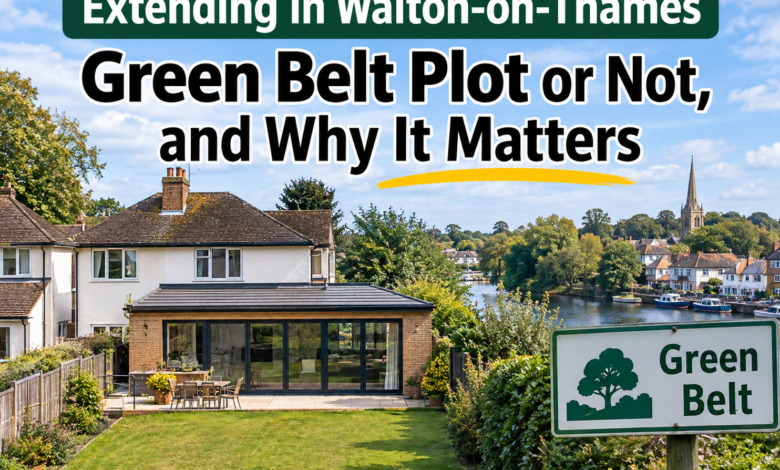
In Walton-on-Thames, the single biggest factor in your extension is not the design or the budget. It is whether your plot sits in the Green Belt. The same house, the same plans, can be a straightforward permitted development job on one street and a carefully argued planning application on the next.
Much of Walton and the wider Elmbridge area falls within the Metropolitan Green Belt, so this is not a rare edge case. Before you commission anything, a house extension here starts with one question: which side of that line are you on?
Why Green Belt Status Decides Everything
The Green Belt is national planning policy designed to keep land open and stop towns merging. It does not ban extensions, but it judges them far more strictly, and that changes the whole project from the first sketch.
On a Green Belt plot, an extension is tested against whether it is a disproportionate addition over the original dwelling, measured against the house as it was built or stood in 1948. The council also assesses the effect on the openness of the Green Belt. In practice that caps how big you can go and almost always means a full planning application to Elmbridge, even for work that would be permitted development elsewhere.
On a plot outside the Green Belt, the normal rules apply, permitted development often does the job, and the project is usually simpler and quicker.
The Two Situations, Side by Side
Here is what actually changes between a Green Belt plot and a non-Green Belt plot in Walton-on-Thames.
| Non-Green Belt plot | Green Belt plot | |
| Planning route | Often permitted development | Almost always full planning application |
| Main test | Within PD size limits | Disproportionate addition over original dwelling |
| Realistic size | Standard PD depths, or larger via prior approval | Capped to a proportionate increase |
| Application fee | None if PD, £548 if an application is needed | £548 householder application |
| Typical timeline | Build-ready sooner, no decision wait | Add the 8-week Elmbridge decision, plus design time |
| Design freedom | Higher | Shaped around openness and proportionality |
The practical takeaway is that a Green Belt plot does not stop you extending. It changes the size you can realistically achieve and the route you take to get there.
How to Find Out Which You Are On
You cannot tell from the street, and your neighbour’s extension is not proof, because Green Belt boundaries and conservation areas can run mid-street. The reliable way is to check your specific address against Elmbridge Borough Council’s planning maps, which show Green Belt land, conservation areas and other designations.
Walton also has a second local factor worth checking at the same time: the river. Riverside parts of the town fall within Thames flood zones, and that brings its own requirements, such as flood risk assessments, on top of anything the Green Belt demands. Elmbridge also has a number of conservation areas that can apply regardless of Green Belt status.
So the first job is not design. It is establishing, precisely, what your plot is carrying.
What You Can Still Build on Green Belt Land
If you are on a Green Belt plot, the news is better than many homeowners fear. Green Belt policy generally allows a proportionate increase over the original dwelling’s size, rather than banning extensions outright.
That means a well-judged rear extension, a loft conversion within the roof, or a modest addition that stays subordinate to the original house can all be achievable, provided they are designed to respect openness and do not read as an oversized new building. Walton’s housing is dominated by detached and 1930s semi detached homes, many of which have the plot size to accommodate a proportionate, well-designed extension.
The key is calibrating the ambition to what the policy allows, and presenting it in an application that answers the Green Belt tests head on. That is exactly where schemes succeed or fail.
Why the Right Order Matters Here
The common and expensive mistake in Walton is designing the extension first, then discovering the Green Belt problem when the application is refused. On a Green Belt plot, the order has to be reversed: establish the status, work out the proportionate size the policy permits, then design within it.
Done that way, a surprising amount is achievable, and the application is built to pass rather than hoping to. Done the other way, you pay for drawings twice and lose months.
This is where joined-up local expertise earns its place. Extension Architecture, a RIBA chartered and ARB registered practice working across Surrey including Walton-on-Thames and the wider Elmbridge area, keeps architects, planning consultants and in-house structural engineers together, so the Green Belt position, the flood risk where relevant, and the design are weighed as one from the start. Working with architects walton on thames homeowners can rely on, who know how Elmbridge applies its Green Belt and conservation rules, is what turns a constrained plot into an approved extension.
The Bottom Line for Walton Homeowners
Walton-on-Thames is a desirable place to own a home precisely because so much of it is protected and green, and that protection is the thing that shapes your extension most. The Green Belt is not a wall, but it is a rulebook, and which plot you own decides which rules you play by.
Find out your plot’s status first, size the project to what the policy genuinely allows, and design it to answer the Green Belt tests. Get that sequence right, and even on protected land, the extension your family needs is usually within reach.