Discovering Nepal Beyond Its Famous Trekking Routes
Ask most people about trekking in Nepal and they’ll mention Everest or Annapurna. Fair enough, those trails are spectacular. They’re also busy, and in peak season the lodges fill up fast. If what you really want is a quieter walk, with stone villages, prayer flags and people who still live the way their grandparents did, you’ll need to look at the restricted regions.
Two of them stand out. The Nar Phu Valley tucks itself behind the Annapurna range, while the Manaslu region wraps around the eighth-highest mountain on Earth. Both lean heavily on Tibetan culture and Buddhist tradition. Yet they feel quite different on foot. The Nar Phu Valley Trek is a deep dive into two isolated villages, and the Manaslu Circuit is a longer loop through changing valleys. This guide walks through both, so you can decide which suits you.
Nar Phu Valley and Manaslu: Two Remote Regions, Different Experiences
Where Are Nar Phu Valley and the Manaslu Region Located?
Nar Phu sits in the Manang district, on the northern side of the Annapurna massif, close to the Tibetan border. Manaslu lies to the east, in the Gorkha district, following the Budhi Gandaki river up towards Tibet. Both need special permits, and both are far less developed than the classic routes. The two meet, in a roundabout way, near Dharapani, which matters if you ever think about combining them.
What Makes These Himalayan Regions Special?
It’s the everyday stuff, honestly. Flat-roofed stone houses stacked up a hillside. Mani walls you walk past on the left, as custom says. Old monasteries where the butter lamps are still lit each morning. Tibetan-influenced communities here have kept their language, food and festivals largely intact, partly because tourism arrived late and in small numbers.
Nar Phu Valley Trek: Exploring Nepal’s Hidden Himalayan Settlements
Trekking Through Koto, Meta, Phu and Nar
The Nar Phu Valley Trek usually leaves the Annapurna Circuit trail at Koto and follows a narrow gorge north. The first stretch is forest, damp and green, with the path cut right into steep rock. Then, quite suddenly, the valley opens into dry, wind-scoured country that looks more like the Tibetan plateau than the Nepal of postcards.
Meta is a small, high settlement and a useful place to adjust to the altitude. Beyond it lies Phu, a cluster of earth-coloured houses crowded onto a ridge, and then Nar, the second village, set in a wider valley with fields and grazing land around it.
Culture, Architecture and Daily Life in Nar Phu
Life up here revolves around the seasons. Families herd yaks, grow barley and potatoes where the soil allows, and many head to lower ground in the harshest part of winter. The monasteries in Phu and Nar are central to village life, and visitors are usually welcome to look around quietly. Meals are simple: tsampa, noodle soup, potatoes, dal bhat. Don’t expect a menu, and don’t expect speed. Hospitality is warm, but supplies are carried in, so patience goes a long way.
What Makes the Nar Phu Valley Trek Challenging?
Altitude, mainly. You spend several days above 4,000 metres, and then the Kang La pass, at roughly 5,300 metres, comes near the end. Lodges are basic, rooms are cold, and some places have little more than a shared bathroom and a stove in the dining room. Weather can turn quickly on the pass, so an early start is normal and a spare day in the schedule is wise.
Manaslu Trek Nepal: A Journey Around the Eighth-Highest Mountain
Exploring the Manaslu Circuit Trekking Route
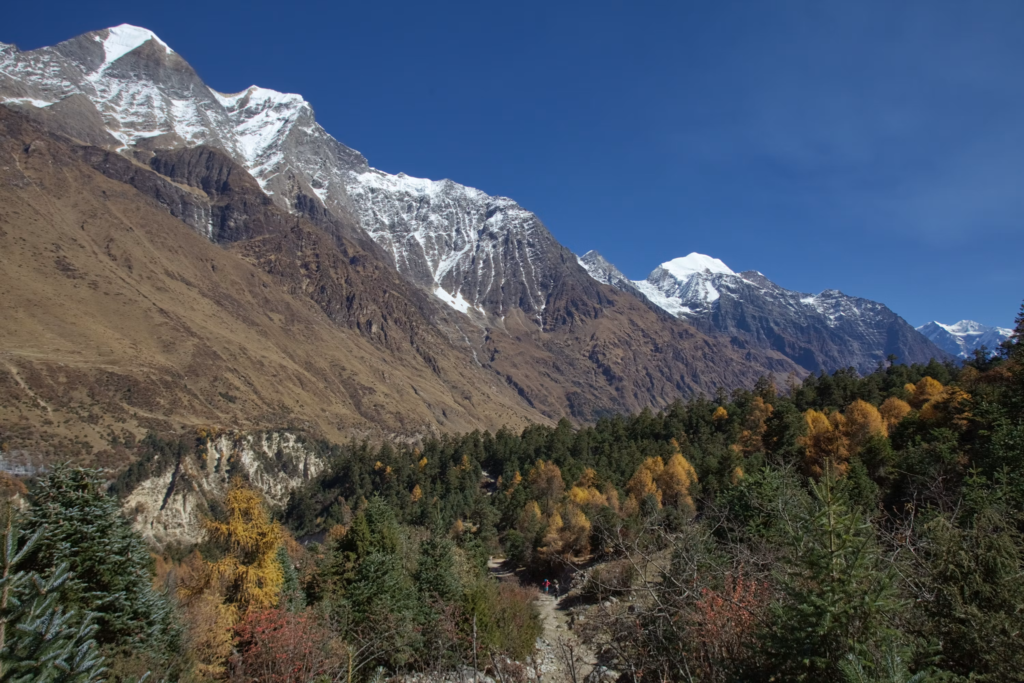
Most itineraries begin with a long drive from Kathmandu to Soti Khola or Machha Khola, depending on road conditions. From there, you follow the Budhi Gandaki upstream, crossing suspension bridges and climbing through terraced hills. Jagat, Deng and Namrung come in turn, and each step up the valley feels a little more Tibetan. This gradual change in landscape, architecture and local traditions is part of what makes the Manaslu Trek Nepal experience so distinctive.
Beyond Lho, Manaslu itself starts to appear above the trees. Samagaun is the big stop, a sizable village where most groups take a rest day, often with a side trip to Pungyen Gompa or the glacial lake nearby. Samdo follows, and then Dharamsala, a stone shelter and a few lodges at the foot of the final climb.
Tibetan Heritage and Traditional Mountain Communities
Mani walls, prayer wheels and monasteries pop up constantly along the Manaslu trail, and many villagers have family links across the border. Locals farm, trade and look after yak herds, and homes often double as lodges. It feels lived-in rather than staged.
Crossing Larkya La Pass
The pass reaches about 5,100 metres, and the day is long, often eight hours or more. You start in the dark, the cold bites, and the final ridge can feel endless. The reward is a huge panorama of glaciers and peaks before the steep drop towards Bhimtang. Acclimatising properly in Samagaun beforehand makes a real difference, and so does keeping an eye on the forecast, because snow can close the pass.
Nar Phu Valley Trek vs Manaslu Circuit: Which Experience Is Different?
Think of Nar Phu as a detour into a hidden pocket, and Manaslu as a full journey. Nar Phu is shorter, drier and more austere, with just two main villages to explore and a very remote feel. Manaslu is longer, greener at the start, and gradually builds up as the valley climbs.
Kang La is steep and rocky, a hard day with a tough descent. Larkya La is higher in feel because of the length, but the approach is more gradual. Lodges on the Manaslu route are a bit more established, while Nar Phu is simpler. If you want deep cultural immersion and don’t mind roughing it, Nar Phu is a great pick, but Manaslu fits trekkers who want variety and a classic circuit.
Combining Nar Phu Valley Trek and Manaslu Circuit: Is It Possible?
Understanding the Combined Trekking Experience
Yes, and it’s a neat fit. The Manaslu Circuit finishes near Dharapani, which is also where the Nar Phu trail begins. So you can walk straight from one into the other, crossing Kang La and rejoining the Annapurna Circuit at Manang. Expect a long trip, often three to four weeks all up, depending on pace, rest days and transfers. Your agency should map out the exact route and permits in advance.
Who Should Consider This Combined Adventure?
Experienced trekkers who are properly fit, comfortable with two high passes in a row, and curious about Tibetan-influenced life. You also need free time, and some flexibility for weather delays.
Best Time for Trekking in Nar Phu Valley and Manaslu
Spring Season
March to May brings warmer days, rhododendrons on the lower slopes and good mountain views, though afternoon cloud is common higher up.
Autumn Season
September to November is the most popular window, with stable weather and sharp, clear views.
Winter and Monsoon Considerations
Winter brings heavy snow that can block both passes, and the monsoon means rain, leeches and landslides on the lower trails. For high passes, season matters a lot.
Restricted Area Permits, Guides and Trekking Regulations
Permits Required for Nar Phu Valley and Manaslu
You’ll need a restricted-area permit for each region: one for Nar Phu, one for Manaslu. Add the Annapurna Conservation Area permit, and for Manaslu the Manaslu Conservation Area permit as well. Fees and rules change, and they depend on your dates, so confirm the current figures with your agency or the Nepal Tourism Board rather than relying on an old blog post.
Why Independent Trekking Is Not a Simple Option
Solo trekking isn’t allowed in these areas. Rules generally require a licensed guide, a registered agency and a minimum group size, usually two people. Permits are issued through authorised agencies, so that’s the practical route.
Accommodation, Food and Practical Trekking Preparation
Teahouses and Accommodation
Simple lodges with twin rooms, thin mattresses and a shared dining room. Higher up, facilities get thinner, and some beds are little more than a plank.
Food and Drinking Water
Dal bhat is the staple, with noodles, soups and rice, and the menu gets shorter the higher you climb. Bring purification tablets or a filter, and avoid untreated water.
Physical Preparation and Essential Equipment
Build up cardio and leg strength for a couple of months. Pack warm layers, broken-in boots, a good sleeping bag and sun protection. Drink plenty, walk slowly, and speak up early if you feel unwell.
Nar Phu Valley and Manaslu Trekking Packages: What Should Be Included?
Understanding Trekking Package Services
A decent package covers a licensed guide and porters, all permits, lodging and meals on the trail, transport from Kathmandu and back, and emergency arrangements. Check what’s left out, such as drinks, gear hire and insurance.
Planning Through Adventure Great Himalaya
Local operators such as Adventure Great Himalaya handle Nepal trekking arrangements, including these restricted routes. Before you confirm anything, talk through your fitness, how many days you actually have, whether you want to combine both regions, and what the price includes.
Frequently Asked Questions About Nar Phu Valley and Manaslu Trekking
Is the Nar Phu Valley Trek suitable for first-time trekkers?
It’s possible with good fitness, but it’s demanding, so some prior altitude experience helps.
How difficult is the Manaslu Circuit Trek?
Moderately hard to hard. Long days and Larkya La are the main tests.
Can Nar Phu Valley and Manaslu Circuit be combined?
Yes, through Dharapani, with extra days.
Do I need a restricted-area permit for both treks?
Yes, each region has its own.
What is the best season for trekking in these regions?
Autumn and spring.
Experiencing Nepal’s Himalayan Culture Beyond the Main Trails
Nar Phu rewards you with isolation and stark beauty, Manaslu with a richer, longer story. Go prepared, respect local customs, and travel with people who know the ground. Do that, and these quiet valleys are well worth the effort.