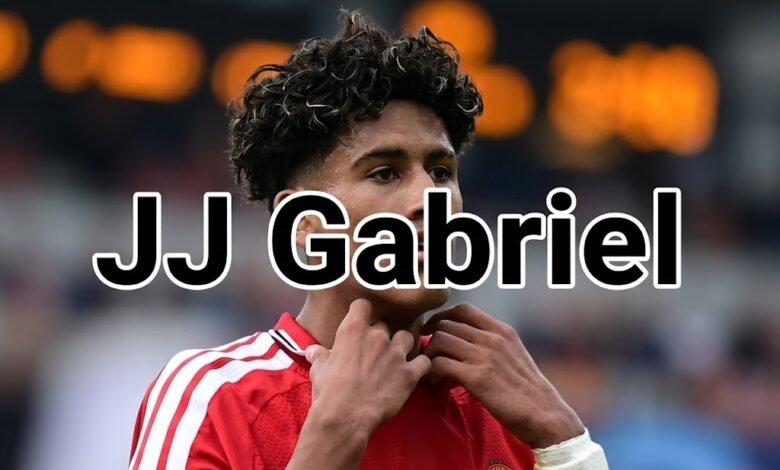
That teenager is Joseph Junior Andreou Gabriel, though almost everybody in football knows him as JJ Gabriel. At fifteen, he does not just play football; he runs games. He dictates terms to players who could pass for men, and he does it with a grin on his face.
The noise surrounding this kid from North London is deafening. Over the past twelve months, his name has bounced from touchline gossip to executive boardrooms across Spain and Germany. He has already smashed historic academy records, signed commercial contracts that put established league players to shame, and found himself right in the crosshairs of an explosive transfer row. Yet, if you sit down and watch his actual game, you see something refreshingly pure. This is not an athlete built on a gym treadmill or manufactured by a marketing team. He is a genuine footballer who learned his craft in the tight, unforgiving spaces of urban football, and the world is finally waking up to it.
Quick Bio and Key Details
| Detail | Fact |
|---|---|
| Full Name | Joseph Junior Andreou O’Cearuill (JJ Gabriel) |
| Date of Birth | 6 October 2010 |
| Age | 15 years old |
| Birthplace | Enfield, Greater London, England |
| Nationality | English, Irish (also eligible for Cyprus and Trinidad & Tobago) |
| Heritage | Greek Cypriot, Irish, Trinidadian |
| Current Club | Manchester United |
| Positions | Left Winger, Second Striker, Attacking Midfielder |
| Parents | Joe O’Cearuill (Father) and Greek Cypriot Mother |
| Marital Status | Single (Minor) |
| Children | None |
| Height | In active youth growth (held internally by academy staff) |
| Weight | In active youth growth (held internally by academy staff) |
| Education | Manchester United Academy Schooling System |
| Accent | North London English |
| Religion | Private |
| Estimated Net Worth | Approximately £850,000 ($1.1 million) |
| Base Youth Wage | £300 to £350 per week (£18,200 annual baseline) |
| Key Sponsorship | Multi-year footwear and apparel agreement with Nike |
Enfield Cages to Carrington: The Early Life of JJ Gabriel
Enfield does not hand out easy rides. If you want to kick a ball on the concrete pitches and wire cages of North London, you have to look after yourself. That was where JJ Gabriel first kicked a football. He spent his early childhood on local estates, taking on bigger boys who did not give a toss about his age. In those tight cages, if you take two seconds to control a bouncing ball, somebody puts you straight through a chain-link fence.
He learned to think two passes ahead. Instead of trying to out-muscle lads twice his size, he learned to drop his hips, roll his studs over the leather, and slip out of trouble before the tackle arrived. That street upbringing gave him an instinctive feel for space that traditional academy drills simply cannot produce.
London Street Football and Futsal Foundations
While his peers were playing weekend games on soggy grass fields, he was spending hours on indoor courts playing futsal. For anyone who studies modern attackers, that detail matters enormously. Futsal uses a smaller, weighted ball that refuses to bounce. You cannot boot it long and run onto it. You must manipulate it with both feet, work in tiny corridors, and use the sole of your shoe to shift angles.
He bounced between the top London academies as a schoolboy. Chelsea had him for a bit. Arsenal took a look. He spent developmental stretches inside Queens Park Rangers and West Ham United. Every youth coach came away with the same note: the boy’s first touch was completely natural. He did not fight the ball. It arrived at his feet and stayed there, almost like it was stuck to his laces.
The Football Bloodline of Joe O’Cearuill
Natural talent helps, but having an ex-professional in your kitchen changes everything. His father is Joe O’Cearuill. Football purists will remember Joe coming through the youth setup at Arsenal as a central defender before going on to play senior international football for the Republic of Ireland. Joe had to scrap through the lower leagues with clubs like Barnet, and he knows just how unforgiving English football can be.
Joe has been the anchor in his son’s life. When scouts started crowding the touchline and agents began offering shiny promises, his father stepped in. Joe made sure his boy stayed on top of his schoolwork, ate clean, slept early, and kept his head down. That parental shield kept him grounded while the circus grew louder by the week.
Four distinct heritages run through the boy’s veins. His father brings Irish and Trinidadian blood. His mother brings Greek Cypriot roots. Born in London, he holds the keys to four different national football shirts. That unique background gives him a global view of the sport, and it has set off a frantic scramble between rival football associations.
How JJ Gabriel Picked Up the “Kid Messi” Tag
Every couple of years, the internet finds an eight-year-old who can juggle an orange and dubs him the next world-beater. Usually, it ruins the boy. When JJ Gabriel was just nine years old, a video of him playing in London blew up on YouTube and social media. The clip showed him picking up the ball near his own goal, dancing past four opponents in five seconds, and rolling a finish into the far corner with his left foot.
The internet immediately branded him “Kid Messi”.
It was an outrageous label to slap on a primary school student. Comparing a child to Lionel Messi is a terrible idea ninety-nine per cent of the time. But anyone who watched the clip understood why viewers gasped. He shared that identical, low centre of gravity. He could sprint flat out, brake instantly without losing balance, and take three touches in the space of half a metre.
Viral Clips and Academy Bidding Wars
The clip brought mayhem. Scouts from every top team in England started camping outside his weekend matches. His family suddenly had to navigate phone calls from representatives wanting to manage his commercial rights before he had even started secondary school.
Manchester United saw something beyond the trickery. They saw a player who took hits, bounced back up, and immediately demanded the ball back. United made their move, presenting a clear path to first-team football that convinced the family to relocate him north to Carrington.
Learning to Cope with Massive Hype
A lot of kids fold under that spotlight. They stop running for the team and start playing for the camera. JJ Gabriel went the other way. Under the watchful eyes of United academy coaches, he worked relentlessly on his physical endurance and his weaker right foot. He stopped relying purely on instinct and started learning the tactical structure of modern pressing football. The viral clips made him famous, but his daily graft made him a genuine prospect.
Smashing Youth Records for Manchester United
The move to Carrington proved to be a masterstroke. Manchester United have made plenty of mistakes at the senior level in recent years, but their youth academy remains one of the finest finishing schools on earth. They do not hold special talents back out of caution; if a player is ready, they push him straight up the ladder.
The Under-18 Breakthrough Against Leeds United
In April 2025, the coaches decided he had outgrown his age group. At only fourteen years of age, they threw him into the starting line-up for an Under-18 Premier League clash against Leeds United. Playing against seventeen-year-olds who are fighting for their professional livelihoods is a brutal test for an undersized teenager.
He tore Leeds apart. He scored twice on his debut, running their defence ragged and creating chances out of nothing.
What followed over the 2025–26 season was an absolute clinic:
- He scored 26 goals in 29 appearances across all youth tournaments.
- He was crowned the Premier League Under-18 Player of the Season for 2025–26, becoming the youngest player to ever win the award.
- He collected United’s prestigious Jimmy Murphy Young Player of the Year trophy.
- He was bumped up into the Under-21 squad, competing against seasoned reserve players without missing a step.
Conquering Europe and Senior Steps Under Michael Carrick
His progress went into overdrive at the start of the 2026–27 campaign. On 10 September 2026, he stepped onto the pitch for his UEFA Youth League debut against Sabah FK. He did not merely participate; he bagged a hat-trick in a 5-0 hammering. That treble made him the youngest goalscorer in Manchester United’s history in European competition.
First-team manager Michael Carrick had seen enough. In August 2026, Carrick put him on the plane with the senior squad for a pre-season friendly against Atletico Madrid at Strawberry Arena in Stockholm. In the 82nd minute, the boy pulled off his warm-up top, slipped onto the pitch, and became the youngest player to ever feature in an unofficial senior match for Manchester United at 15 years and 299 days.
What Makes the Playing Style of JJ Gabriel So Devastating?
Modern defenders hate playing against him because he does not follow predictable scripts. Most wingers today receive the ball, wait for their full-back to overlap, and whip in a high ball. He wants to play the game on his terms.
He plays primarily off the left wing, but he is not a touchline hugger. He picks up the ball in the half-space between the opponent’s right-back and centre-back. That position causes absolute panic. If the full-back comes inside to press him, he slips a pass to his overlapping defender. If the centre-back steps out, he cuts behind them with a vicious burst of acceleration.
Low Gravity, Fast Feet, and Cold Finishing
His biggest asset is his body control. When he drops his left shoulder, defenders naturally commit their weight in that direction. The moment they lean, he pushes the ball with the outside of his right boot and explodes through the gap. You cannot foul him easily because his balance keeps him upright even after heavy contact.
Inside the penalty area, his head does not spin. He rarely smashes a shot with pure power. Instead, he treats finishing like a pass, rolling the ball into the side netting or dinking it over an oncoming keeper. That level of calm in front of goal is something you cannot drill into a player; you either have it or you do not.
The Financial Reality and Earnings of JJ Gabriel
There is a huge misconception about what teenage footballers earn. Under Football Association youth guidelines, minors cannot sign professional contracts until they turn seventeen. That means he is currently on an academy scholarship contract. His weekly club wage sits between £300 and £350 per week, working out to about £18,200 annually.
That is standard money for any school-leaver in the country. Where his situation turns completely unprecedented is in his commercial marketability.
That Historic Nike Contract at Age Fourteen
In March 2025, Nike stepped in and broke their own usual protocol by offering him a lucrative, multi-year commercial contract. Nike only signs fourteen-year-olds when their talent spotters believe they are looking at a generational icon.
Add to that his booming value in the sports card world. An exclusive 1-of-1 24-carat gold Topps trading card featuring his portrait was recently released, triggering crazy bidding wars among overseas investors. Today, his overall net worth is pinned at approximately £850,000, roughly $1.1 million.
Because he is fifteen, he does not own private limited companies or run business ventures. Every penny goes into managed family trusts. His parents have made sure the commercial side runs quietly in the background so he can wake up every day thinking about football, not bank accounts.
Four Flags: The International Battle Over JJ Gabriel
International football can be ruthless when a wonderkid emerges. Because of his ancestry, four different countries have been tracking his development since he was twelve.
He has worn the Three Lions up to this point. He made his debut for England Under-15s in February 2025 and moved up into the England Under-17 squad by March 2026 for UEFA European Championship qualifiers. The Football Association wants to build their future attacking line around him.
Yet the Football Association of Ireland has not backed off. With his father having played for the Irish senior team, the emotional connection to Dublin runs deep. Ireland can offer him something England cannot: an immediate fast-track into the senior team.
Cyprus and Trinidad & Tobago are also watching closely. FIFA rules state that until he makes a competitive senior appearance, he can switch allegiance. That makes him one of the most pursued teenage internationals on the planet.
The September Standoff: Barcelona and the Contract Drama
Everything seemed peaceful until mid-September 2026. Michael Carrick was preparing his squad for a Carabao Cup match against Brighton at Old Trafford. Carrick planned to hand the teenager his competitive senior debut, making him the youngest competitive first-team player in Manchester United’s history.
Then, news broke that shook Carrington.
JJ Gabriel and his camp submitted an official request to cancel his youth registration, seeking a departure from the club.
The timing caught everyone off guard. Manchester United believed they had laid out the perfect red carpet for him. But elite clubs across Europe, most notably FC Barcelona, had spotted a unique legal angle.
The Irish Passport Factor and Brexit Rules
Post-Brexit rules prevent British clubs from signing foreign youngsters under eighteen, while English players cannot sign professional terms until seventeen. However, because his father gave him an Irish passport, JJ Gabriel is an EU citizen.
Under FIFA transfer regulations, an EU citizen can move to an EU club the moment he turns sixteen. He turns sixteen on 6 October 2026. If he walks away from Manchester, Barcelona can sign him to a professional deal months before United are legally allowed to offer one.
United have dug their heels in. The club insists his youth registration remains valid under FA rules through the end of the season, and internal talks are ongoing to try and fix the relationship before October arrives.
What Lies Ahead for JJ Gabriel
We have seen this film before in football. An incredible kid bursts onto the scene, the hype goes through the roof, and five years later he is playing non-league football. The step from youth matches to the Premier League is savage. Senior centre-backs do not care about viral dribbles or Nike boots; they will smash you into the advertising boards to protect their clean sheet.
What separates JJ Gabriel from the casualties of the past is his attitude. Those who work with him at Carrington describe a boy who is the first onto the training ground and the last off it. He takes criticism without sulking. When he loses the ball, he sprints forty yards back to tackle his opponent.
Whether he sorts out his differences with Manchester United or heads to Barcelona to write a new chapter in Spain, one thing is certain: JJ Gabriel has the talent, the composure, and the football brain to become one of the game’s genuine superstars. The world will be watching when the clock strikes midnight on his sixteenth birthday.
FAQs
Who is JJ Gabriel?
Joseph Junior Andreou Gabriel (born Joseph Junior Andreou O’Cearuill) is an English youth footballer and attacker for Manchester United. Nicknamed “Kid Messi” for his close ball control, agility, and dribbling, he made headlines after becoming United’s youngest-ever Under-18 player and scoring a hat-trick on his UEFA Youth League debut.
How old is JJ Gabriel?
He is 15 years old. He was born on 6 October 2010 in Enfield, Greater London.
Who are JJ Gabriel’s parents?
His father is Joe O’Cearuill, a former professional centre-back who came through Arsenal’s academy and represented the Republic of Ireland at senior international level. His mother is of Greek Cypriot descent.
Is JJ Gabriel married?
No. As a 15-year-old minor and academy schoolboy, he is unmarried and has no spouse or children.
Does JJ Gabriel have siblings?
He has no publicly documented brothers or sisters; his family keeps their domestic life private to shield their household from media attention.