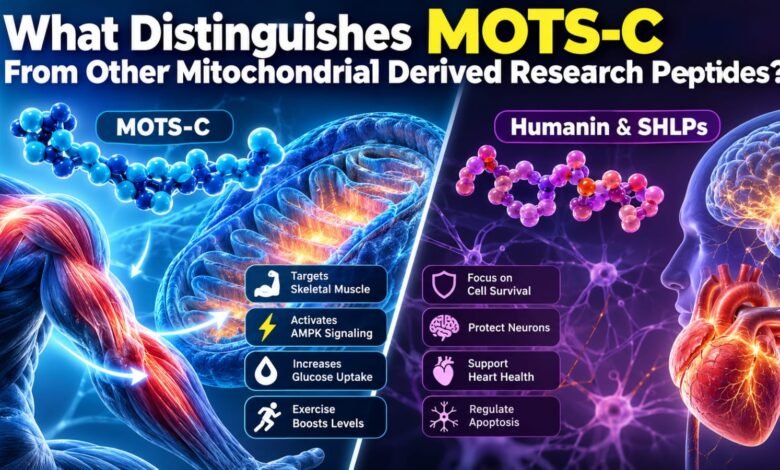
Mitochondrial DNA was once dismissed as a tiny instruction manual. Its ribosomal RNA genes, however, hide short coding sequences. From these come small signaling molecules called MDPs. Each one carries a distinct job in the cell. Small size hides surprisingly broad influence. The mots c peptide travels further than its relatives. It reshapes muscle metabolism and even enters the nucleus. Humanin and the SHLP family follow a different script. Cell survival, not fuel use, drives that family. Gene origin, molecular target, and physiological reach explain the gap.
A Separate rRNA Gene Encodes MOTS-c
Location on the mitochondrial genome offers the first clue. MOTS-c comes from the 12S rRNA gene, MT-RNR1. Humanin and six SHLPs sit on the 16S gene instead. The resulting chain holds 16 amino acids. Humanin carries 24 residues by comparison. SHLP lengths stretch from 20 to 38. Separate genes imply distinct regulation and evolutionary history.
Which Tissue Does MOTS-c Target Most?
Skeletal muscle serves as its primary destination.
- It blocks the folate cycle in those fibers.
- Stalled folate flux lets AICAR build up inside.
- Rising AICAR then switches on AMPK signaling.
- Glucose uptake from the blood rises sharply.
- Treated mice on high-fat diets resisted weight gain.
Humanin, by contrast, mainly shields neurons and heart tissue.
Nuclear Entry Under Metabolic Stress
Glucose restriction or oxidative stress sends MOTS-c somewhere surprising. In cultured cells, the molecule moves into the nucleus. There, alongside NRF2, it adjusts genes carrying antioxidant response elements. This makes the mots c peptide a two-genome messenger. Few organelle-encoded signals cross that boundary at all. Humanin works mainly through surface receptors like FPRL1.
Why Does Exercise Raise MOTS-c Levels?
Physical effort works as a built-in trigger. In sedentary young men, muscle levels jumped roughly twelvefold after cycling. Blood concentrations climbed too, then settled during recovery. Mice treated late in life ran longer on treadmills. Grip strength improved as well. Such findings earn the compound an “exercise mimetic” label. Humanin research shows no comparable training link.
What Roles Do Humanin and SHLPs Fill?
Humanin-family biology leans toward cell survival over fuel handling:
- Humanin binds BAX, halting apoptosis.
- It shields neurons from amyloid toxicity.
- SHLP2 boosts insulin sensitivity centrally.
- SHLP3 lifts mitochondrial respiration in cells.
- SHLP6 promotes cell death instead.
Even so, outcomes differ sharply across family members. Protection, not metabolic retuning, defines this branch.
One Gene Variant Reveals Its Weight
A single DNA letter sharpens the picture. The m.1382A>C variant swaps lysine for glutamine at position 14. Japanese men carrying it faced higher diabetes risk. For a 16-residue chain, one swap carries real consequences. Small molecules leave little room for error. Exercise-driven release makes that variant even more telling. That sensitivity reframes MOTS-c as hormone-like, not merely mitochondrial. Its message runs from organelle to muscle to whole-body health.
FAQs
Is MOTS-c encoded in nuclear or mitochondrial DNA?
Its sequence lies in the mitochondrial 12S rRNA gene, and translation is thought to occur in the cytoplasm. Cytosolic ribosomes read it using the standard genetic code, a finding first reported by a 2015 USC study.
How small is MOTS-c compared with humanin?
MOTS-c contains 16 amino acids, while humanin holds 24 and was identified earlier, back in 2001. Both remain tiny next to typical signaling proteins, and short chains make lab synthesis straightforward.
Does exercise affect MOTS-c levels in humans?
Yes, muscle samples from sedentary young men show sharp rises after cycling, and circulating levels climb too. Concentrations drift back toward baseline during rest, and mouse studies show similar exercise-linked increases.
What makes SHLPs a separate group?
SHLPs come from the 16S rRNA gene near humanin’s region, and the family was first described in 2016. Six variants exist, with effects ranging from protective to openly pro-apoptotic.