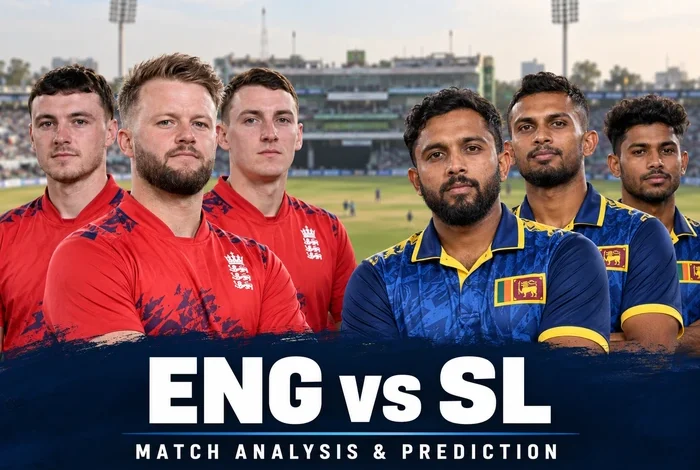
England have taken control with the bat against Sri Lanka in Lahore, setting up another tense contest between two sides who have already produced a remarkable match in this tournament. Ben Duckett has led the scoring, while Tom Banton and Harry Brook have helped build a platform for a strong finish.
Yet England know that runs alone will not settle this game. Sri Lanka chased down 430 in their previous meeting, exposing weaknesses that England must address when they return to the field.
This Eng vs Sl article covers the match at 265/1 after 37 overs on 29 October 2026. It includes the action up to that point and a prediction based on that position. The final result was not available at this cutoff.
Eng vs Sl Quick Match Facts
| Match detail | Position at the article cutoff |
|---|---|
| Teams | England and Sri Lanka |
| Competition | Pakistan ODI Tri-Series 2026 |
| Fixture | Sixth match |
| Date | 29 October 2026 |
| Venue | Gaddafi Stadium, Lahore |
| Format | One Day International |
| Scheduled start | 1:00 PM Pakistan time |
| Toss | Sri Lanka chose to bowl |
| England score | 265/1 after 37 overs |
| Ben Duckett | 148 not out from 116 balls |
| Harry Brook | 40 not out from 32 balls |
| Tom Banton | Bowled for 74 from 75 balls |
| Wicket taker | Dasun Shanaka |
| Match prediction | England, with moderate confidence |
Eng vs Sl Opening Partnership Gives England Control
Banton and Duckett provided the start England needed. Their opening stand reached 163, allowing the middle order to enter with wickets available and a healthy scoring rate.
Banton made 74 from 75 deliveries, hitting eight fours and two sixes. He kept the innings moving without needing to attack every ball. His contribution also prevented Sri Lanka from focusing all their pressure on Duckett.
The breakthrough came from Shanaka on the final delivery of the 25th over. Banton was bowled, ending a partnership that had shaped the first half of the innings.
For Sri Lanka, that wicket offered a chance to slow England down. However, one dismissal was not enough to change the direction of the game. They needed another breakthrough before the next partnership could settle.
Why the Opening Stand Mattered
A large opening partnership gives a batting side freedom. Incoming players can assess the bowling without facing an immediate rescue job.
England earned that freedom here. Their challenge was to use it well, rather than assume the strong start would automatically produce a winning total.
Ben Duckett Leads the Eng vs Sl Batting Effort
Duckett was unbeaten on 148 from 116 balls at the cutoff. His innings contained 22 fours and no sixes, showing how much damage he had done through placement and regular boundary scoring.
That balance matters in a long innings. A batter does not need repeated lofted shots to maintain pressure. Finding gaps and punishing loose deliveries can force changes to both the bowling plan and the field.
Duckett also gave England continuity. He stayed at the crease through the opening partnership and then helped Brook build another substantial stand.
His next task was to carry that control into the closing overs. With plenty of batting still available, England could increase their ambition. Even so, keeping a settled batter involved would reduce the risk of a sudden slowdown.
Duckett’s Value Beyond His Personal Score
A long innings gives a batter time to judge the surface, pace and bounce. That experience can become especially useful when bowlers introduce slower deliveries.
Duckett’s presence also allowed his partner to play with greater freedom. England did not need both batters to force the pace on every delivery.
Harry Brook Builds on England’s Strong Start
Brook reached 40 from 32 balls, including two fours and two sixes. Together, he and Duckett had added an unbeaten 102 from 72 deliveries.
That stand kept Sri Lanka from gaining lasting control after Banton’s dismissal. Instead of rebuilding cautiously, England continued to score quickly enough to put pressure on the remaining bowling resources.
Brook had already shown his attacking range against this opposition earlier in the tournament. Here, his role was to support the established innings while taking advantage of opportunities to accelerate.
The partnership gave England options. They could target favourable deliveries, rotate the strike when boundaries were protected and preserve enough wickets for the final push.
The Importance of Choosing the Right Ball
Aggressive batting does not require a boundary attempt every time. A single can bring the better placed batter on strike and disrupt a bowler’s plan.
For England, measured aggression offered a stronger route to a major total than a burst of unnecessary risks.
Sri Lanka’s Bowling Figures Reveal the Challenge
Shanaka had taken 1/21 from four overs, providing both the breakthrough and a measure of control. Asitha Fernando had conceded 27 from six overs.
Other spells had been more expensive. Eshan Malinga had conceded 67 from six overs, while Dunith Wellalage had given away the same number from nine.
Those figures explain Sri Lanka’s position. Some bowlers had limited the scoring, but England had found enough productive overs elsewhere to maintain momentum.
The immediate need was wickets. Restricting singles would help, but removing a settled batter could have a greater effect on the closing total.
Sri Lanka also needed discipline in the field. Clean stops, accurate returns and secure catching could prevent a difficult innings from becoming even more costly.
How Sri Lanka Could Recover
Two wickets in a short spell would force England to reassess their approach. New batters would have less time to settle before attacking.
Without those breakthroughs, Sri Lanka would have to contain players who already had a clear feel for the conditions.
Eng vs Sl Previous Meeting Offers a Warning
England’s earlier match against Sri Lanka ended in defeat despite a total of 429/4. Brook scored 202, yet Sri Lanka reached 430/8 with one ball remaining.
It was a clear reminder that a huge first innings can still leave unfinished work. England’s bowlers must create pressure and take wickets, whatever target they defend.
Pavan Rathnayake made 130 in that chase. Avishka Fernando and Shanaka each scored 97, while Janith Liyanage finished unbeaten on 61 from 27 balls.
The spread of contributions matters. Sri Lanka did not depend on one exceptional innings. Different batters carried the chase through different stages.
England therefore need more than an early breakthrough. They must keep making progress through the batting order and avoid allowing a late partnership to take control.
What England Must Learn
Defending a total requires clear plans under pressure. Bowlers need suitable fields and must commit to their chosen length.
England also need to respond quickly when a partnership gathers pace, rather than wait for the required scoring rate to solve the problem.
Tournament Form Adds Context to the Contest
England entered this match after three defeats and were already out of contention for the final. Their previous game against Pakistan ended in a one-wicket loss.
Duckett scored 105 in that match, but England could not finish the job with the ball. Pakistan recovered from 154/9 through a decisive final partnership led by Shadab Khan.
Sri Lanka arrived after beating Pakistan by eight wickets. Madushanka took five wickets for 34 as the hosts were dismissed for 110.
Kamindu Mendis then made an unbeaten 62 during the chase. That victory secured Sri Lanka’s place in the final against Pakistan.
These results create an important contrast. England held the stronger position at this article’s cutoff, but Sri Lanka entered with greater success behind them. Current match control and recent form do not always point towards the same team.
How High Could England’s Total Go?
With 13 overs remaining, England had enough time to add substantial runs. However, any projected total must remain separate from the actual score.
Seven runs per over for the remaining overs would take them to 356. Eight per over would produce 369, while nine per over would bring the total to 382.
These are simple scenarios, not promised outcomes. Wickets, accurate bowling and missed scoring chances could all change the finish.
England’s strongest approach would be to keep building pressure while preserving their ability to attack late. Sri Lanka’s best response would be to break the partnership before the final overs begin.
Why the Final Overs Matter
A difference of 20 or 30 runs can alter the chase. It can force earlier risks and reduce the value of quiet overs.
However, the previous meeting means England cannot treat any projected total as automatic protection.
Eng vs Sl Prediction: England Hold the Advantage
England are my choice to win from the stated position, with moderate confidence. Their batting platform gives them the clearest immediate route to victory.
The prediction depends on completing the innings well and then taking wickets during Sri Lanka’s reply. A strong score would give England room to attack, but their bowling must support that advantage.
Sri Lanka remain capable of changing the contest. A late burst of wickets could reduce the target, while a productive opening stand could make the chase feel manageable.
For that reason, a precise winning percentage would give a false sense of certainty. The evidence supports England as the stronger choice at this stage, while leaving a realistic path for Sri Lanka.
Conclusion: England Must Finish What They Started
England have earned a strong position through patient opening work and sustained scoring. Their next challenge is to turn that advantage into a complete performance across both innings.
Sri Lanka still have time to respond, first by controlling the finish and then by building partnerships. England are the prediction at the cutoff, but the match remains open until the final wicket or winning run.
FAQs
Where is the Eng vs Sl match being played?
The match is being played at Gaddafi Stadium in Lahore as part of the Pakistan ODI Tri-Series 2026.
Who won the toss in Eng vs Sl?
Sri Lanka won the toss and chose to bowl first, giving England the opening innings.
What was England’s score at the article’s cutoff?
England were 265/1 after 37 overs. Ben Duckett was unbeaten on 148, while Harry Brook had 40.
Who took England’s first wicket?
Dasun Shanaka bowled Tom Banton for 74 from 75 balls, ending England’s opening partnership of 163.
Who is predicted to win Eng vs Sl?
England are the article’s predicted winners based on their strong batting position. However, Sri Lanka’s successful chase of 430 in the previous meeting means the result remains uncertain.