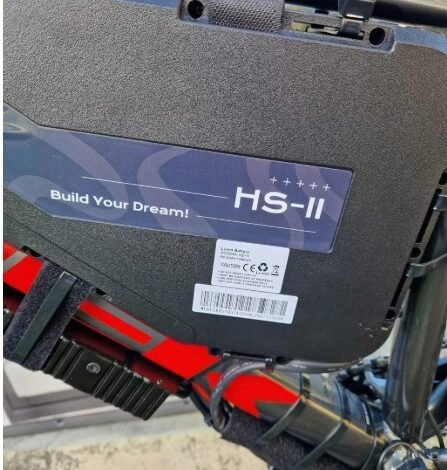
Most battery fit problems have nothing to do with electronics. The pack has the right voltage and plenty of watt-hours, and then it touches the top tube, lands on bottle-cage bosses that sit 15 mm too high, or fits beautifully and cannot be slid off to charge.
The short answer: a triangle-shaped pack makes the most of a large, open main triangle, while a down-tube pack suits frames with a long, straight down tube and little height under the top tube. Which one belongs on your bike is decided by three checks, in this order: the frame pocket, the mounting points and the removal path. Capacity comes last.
Key takeaways
- Choose by frame pocket, mounting points and removal path, in that order. Capacity is the last decision, not the first.
- Triangle packs suit large, open main triangles and keep weight central. Down-tube packs suit long, straight down tubes and frames with little height under the top tube.
- Frame size labels do not predict battery space. A sloping top tube can shrink a large frame’s usable triangle below a medium frame’s.
- The most common failure is removal, not fit: the pack sits in the frame but cannot slide off the rail to charge.
- Two bottle-cage bosses alone are not a battery mount for a 6–8 kg pack. Use a rail plus a backing plate or rated clamps, and never drill the frame.
Triangle vs down-tube ebike battery: what the labels actually mean
“Triangle” is a case shape. The pack is tall at the back and tapers towards the head tube, filling the space between seat tube, top tube and down tube. “Down-tube” is a position. A long, slim case sits on a rail that bolts to the bottle-cage bosses. Some triangle cases also bolt to the down tube, so the two labels overlap more than shop filters suggest.
What actually separates them on a bike:
- A triangle case trades length for height. It needs a tall pocket, and it usually takes the space where your bottle cage was.
- A down-tube case trades height for length. It sits on a rail that adds length and lifts the pack a few millimetres off the tube, and it takes the bottle-cage bosses themselves.
- They load the frame differently. A triangle case often hangs from the top tube and down tube with a plate and clamps. A down-tube case leans on two small bosses plus the rail.
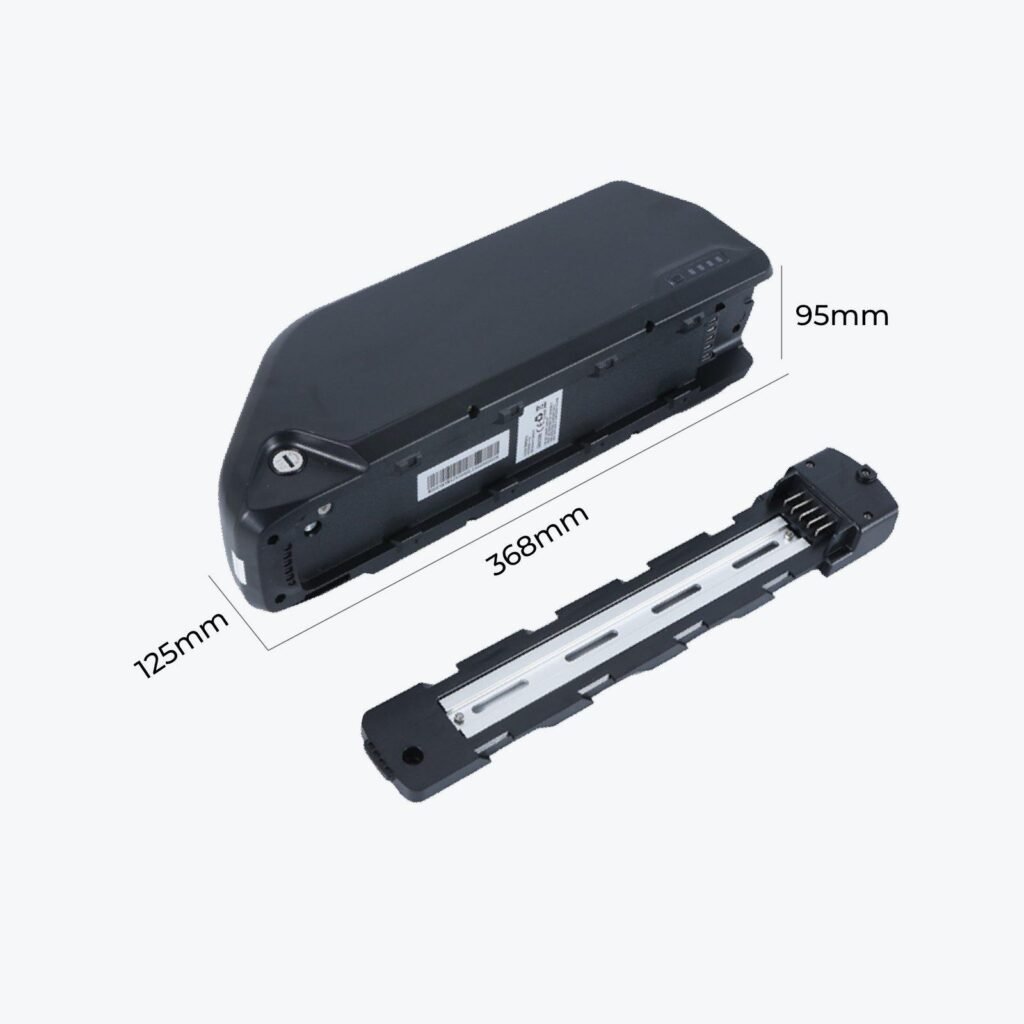
A down-tube case and its rail. The rail adds length and lifts the pack, so measure the two together.
How each shape changes the way the bike rides
A 52V 30Ah battery weighs around 7–8 kg. Where that weight sits changes the bike more than most riders expect.
A triangle pack keeps the mass central. It sits between your knees, close to the bike’s centre of gravity, and slightly higher than a down-tube pack. On a hardtail this feels neutral: the bike leans into corners naturally, and the front wheel stays light enough to lift over a kerb. The trade-off is that the mass is a little higher, so a fully loaded bike can feel top-heavy when you push it by hand or lean it on a stand.
A down-tube pack sits lower and further forward. That makes the bike feel planted in a straight line and helps keep the front wheel down on steep climbs, which matters on a powerful rear-hub conversion that wants to lift the front. It also puts more weight on the front tyre under braking, which is useful. The downside is that it can hang close to the chainring and front tyre on small frames, so check heel and tyre clearance with the bars fully turned.
A rear-rack pack is the outlier. It puts the weight high and behind the rider, which makes the front end light and the steering vague, especially with a rear hub motor adding more weight at the back. Riders choose it because it fits almost any frame, not because it handles well.
Measure the pocket, not the frame size
A frame size is measured along the seat tube. It says almost nothing about battery space. A large frame with a steeply sloping top tube can have a smaller usable triangle than a medium frame with a level one.
Measure with the bike on its wheels and the bars straight:
- Usable down-tube length, from the head tube (or the first cable guide) to the front derailleur or bottom-bracket shell.
- Height under the top tube at three points: front, middle and rear. On a sloping top tube, a single figure is useless.
- Width at the narrowest point between the tubes, plus room for your knees.
- Bottle-boss spacing, centre to centre. Most frames use 64 mm, but measure yours, because a rail only has a few millimetres of slot adjustment.
- Anything already in the space: cable guides, a front-derailleur clamp, a shock or its linkage.
Then make a cardboard template of the exact case, including its rail and the connector, and hold it in place. If you are working from a printed drawing, draw a 100 mm line on the same sheet and check it with a ruler before you cut. Printers default to “fit to page” and quietly shrink everything by a few per cent, which is enough to turn a fail into a false pass.
The test most buyers skip: getting the battery out again
Rail-mounted packs come off by sliding along the rail, usually towards the head tube or upwards at an angle. Mark that direction on your template and slide it the full release distance. If the top tube or a cable guide blocks the slide before the pack clears the rail, you have a battery that needs a spanner every time you charge it.
This is the classic failure on small hardtails with sloping top tubes: the pack fits when mounted and is trapped when you try to remove it. While you have the template in place, check three small things too:
- The key turns with gloves on, and there is room for your hand around it.
- The charge port can be reached with the pack on the bike.
- The output cable makes a gentle bend, not a kink against the head tube.
Hard case, soft bag or rack: the other two options
Not every “triangle battery” is a rigid case. Many cheaper packs are cells wrapped in a soft frame bag that straps to the tubes. They fit oddly shaped triangles and cost less, but they move on rough ground, the straps loosen over time, and the bag offers little protection if the bike falls over. Water also finds its way into zips and seams. For a commuter bike that lives outside, a hard case with a locking mount is worth the extra.
Rear-rack batteries fit almost any bike, including step-throughs and full-suspension frames with no usable triangle. Check the rack’s own load rating, because many racks are rated for less than a battery plus a pannier, and make sure the battery’s rail is designed to bolt to that rack. Expect a longer cable run back to the controller, and route it where it cannot catch the rear tyre.
If your frame genuinely cannot take a frame-mounted pack, rack mounting is the honest answer. Forcing a bigger case into a pocket that is too small is not.
Full suspension: check the space while the shock moves
Space that looks empty with the bike standing still can be filled by the shock, the linkage or the rear tyre under compression. Check clearance through the travel using the frame maker’s procedure, and do not simply let the air out of a shock unless you know how to reset it.
Plenty of full-suspension frames only take a short down-tube pack or a rack-mounted battery. Some take nothing sensible at all. That is a reason to choose a different donor bike, not to force a larger battery into a space that closes up on the first big hit.
Mounting points decide whether it stays put
Two M5 bottle-cage bosses were designed to hold a bottle of water, not a 6–8 kg battery hammering over potholes. A rail spreads that load. Many builders add a backing plate with hose clamps so the pack cannot rotate around the tube.
If the bosses are in the wrong place, the rail moves the battery with them. Bosses set high push the pack up into the top tube and close the removal path. Bosses set low move it towards the chainring, where heel and crank clearance become the problem.
Two things not to do: drill a frame (never a carbon one, and no other frame without the maker’s approval), or rely on a strap alone to hold a hard-case pack.
A worked example with a real triangle case
Triangle cases are hard to template because a single “height” figure tells you nothing about a sloping edge. That is why a fully labelled drawing is worth asking for. The HS-II case below is a good example: its drawing gives a 360.6 mm straight edge, a 281.3 mm sloped edge, a 195.3 mm base and a 131.6 mm short end, all at 97 mm thick.
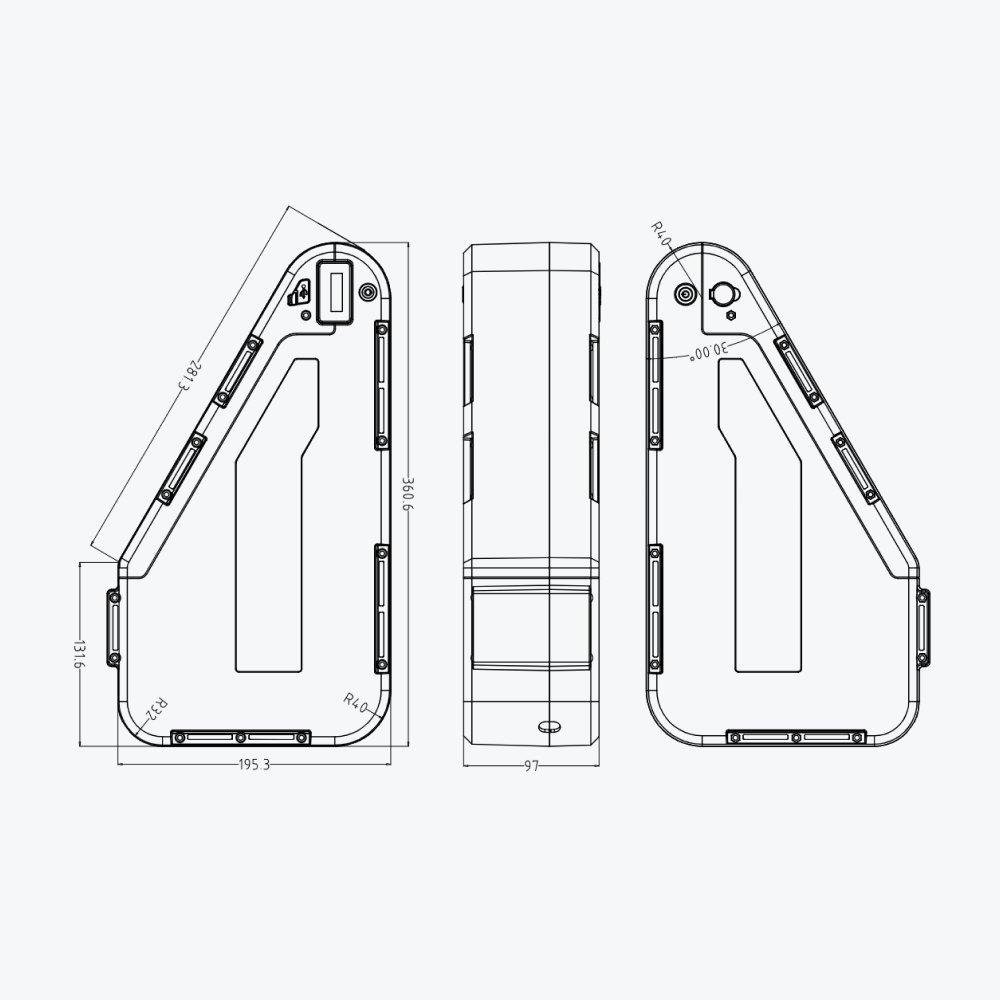
The HS-II case drawing labels every edge, which is what you need to cut an accurate template.
Cut that outline at full size, add the mounting plate, and you can test it in a frame in about ten minutes. If it clears the tubes and slides off cleanly, the KirbEbike HS-II battery is a 52V 30Ah (1,560 Wh) triangle pack with a 60A BMS, and the same case is also sold at 60V and 72V. If it does not clear, no amount of extra capacity makes it the right pack for that frame.
Only then compare capacity
Energy is voltage multiplied by amp-hours. A 52V 25Ah pack holds 1,300 Wh, a 52V 30Ah pack 1,560 Wh.
Take a rider with a 30-mile route who uses about 25 Wh per mile. The trip needs roughly 750 Wh. Keep a 20% reserve and the 25Ah pack leaves about 1,040 Wh to plan with, the 30Ah pack about 1,248 Wh. Both cover the ride. If the smaller pack is easier to slide out and lighter to carry upstairs to charge, it is the better buy for that rider. The bigger one earns its place when the route grows, charging is unavailable, or the bike is ridden hard.
Check current as well as capacity. The battery management system’s continuous rating should sit comfortably above what the controller draws. A 52V pack behind a 35A controller needs a BMS rated well above 35A continuous, not one that only reaches it as a peak.
Five fit mistakes worth avoiding
- Buying from the photo. Product photos are shot at flattering angles. Use the dimensioned drawing, never an image.
- Measuring the case and forgetting the rail. The rail and its mounting plate add length and lift the pack off the tube. On a tight frame, those few millimetres decide the fit.
- Ignoring the charge port. If the port faces the down tube or sits behind the seat tube, you will be charging by touch every night.
- Assuming bosses are in the right place. Bosses are positioned for a bottle cage, not a battery. A few millimetres high or low moves the whole pack.
- Testing fit, not removal. Always slide the template off the rail in its release direction before you order.
Which shape suits which frame
| Your frame | Usually the better fit | Why |
| Large hardtail, level top tube | Triangle | Uses the height, so more cells fit |
| Small or sloping-top-tube hardtail | Down-tube | The removal path usually stays clear |
| Full suspension | Short down-tube or rack | Shock travel takes the triangle space |
| Step-through or folding | Down-tube or rack | There is no closed triangle to fill |
Once you have your three measurements, compare KirbEbike battery options by their case drawings rather than by the capacity in the product title. A pack that fits, locks and slides out easily will get charged and used. One that needs tools to remove usually ends up living in the frame.
Questions worth settling before checkout
Can I keep my bottle cage?
Sometimes. A triangle pack usually takes the cage space, and a down-tube pack takes the bosses. Test both in position, including pulling the bottle out. A cage that still bolts on can be unusable once the battery is fitted.
Does a bigger frame mean more battery space?
Not reliably. Top-tube slope, suspension layout and boss position matter more than the size sticker. Measure the pocket itself.
Can I move the same battery to another bike later?
Only after repeating all three checks on the new frame and confirming the controller accepts the battery’s full-charge voltage. Matching plugs do not prove compatibility.
How much clearance should I leave?
Enough to slide the pack off and get your fingers around the key, plus a margin for cables and paint. A template that fits with nothing to spare is a fail in practice.
Does a triangle battery affect handling?
Slightly, and usually for the better on a hardtail: it keeps the weight central. A down-tube pack sits lower and further forward, which helps keep the front wheel down on steep climbs.
Are triangle batteries bigger than down-tube batteries?
Often, because a triangle case can hold more cells in a large open frame. The HS-II, for example, is offered as 52V 30Ah. But capacity depends on the cell layout, not the shape, so compare watt-hours, not looks.
Can I mount a down-tube battery underneath the down tube?
Some riders do, but it puts the pack in the firing line for water, mud and stones, and most rails are not designed for it. Check with the battery maker before mounting it upside down.
Sources
- UK Government, “Battery safety for e-cycle users” (gov.uk)