In 1631 a printer in the Baltic port of Stettin ran off a news-sheet to satisfy local curiosity. Foreign soldiers had arrived in the town, and the citizens had never seen anything like them.
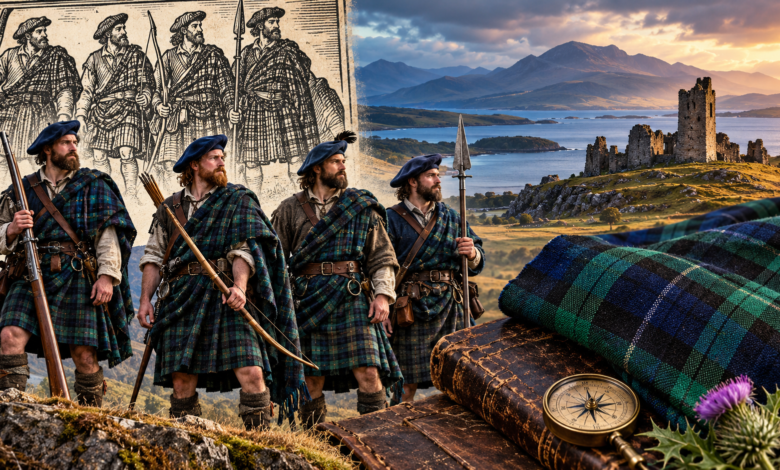
The woodcut shows four men. They are bearded and bare-legged. One carries a musket, one a longbow. All of them are wrapped in a great length of cloth, belted at the waist and thrown over the shoulder, and the artist has taken trouble to show that the cloth is covered in a pattern of crossing lines. The caption describes them as a strong, hardy people who can march prodigious distances in a day and, if they have no bread, will live on roots. They were Highlanders of Mackay’s Regiment, raised in Strathnaver for the King of Sweden’s wars, and the clan that sent them still wears the dark MacKay tartan.
Historians of costume prize that sheet of paper. It is one of the earliest pictures in existence of Highlanders wearing tartan. The men in it were the better part of a thousand miles from home. They were soldiers of Mackay’s Regiment, from the north coast of Scotland, and they were in Germany to fight for the King of Sweden.
Three thousand men from the edge of the map
The country they came from is called Strathnaver. It is the north-western corner of the Scottish mainland: the parishes of Farr, Tongue, Durness and Eddrachillis, a land of sea lochs, empty moor and one long green valley running inland from the coast. In the seventeenth century it belonged to Clann Mhic Aoidh, the children of the son of Aodh. In English, Mackay. Their motto was Manu forti, with a strong hand, and their chief lived at Tongue under the ruined tower of Castle Varrich.
In 1626 the chief was Sir Donald Mackay, thirty-five years old, ambitious, and short of money. Europe was eight years into the Thirty Years’ War. Protestant princes were paying well for soldiers, and Strathnaver had very little to export except men. Sir Donald obtained a commission to raise a regiment, and that autumn some three thousand recruits embarked at Cromarty for the Continent.
They served first under the King of Denmark. In 1627 they held the Pass of Oldenburg for a long day against an imperial army many times their number. In 1628 they helped defend the port of Stralsund against Wallenstein. When the Danes made peace, the regiment transferred to the greatest captain of the age, Gustavus Adolphus of Sweden, and fought in his victory at Breitenfeld in 1631, the year the Stettin printer made his woodcut.
We know all this in unusual detail because one of the officers wrote it down. Robert Monro published his account in London in 1637 under a title that begins Monro, His Expedition with the Worthy Scots Regiment called Mac-Keyes. It is reckoned one of the first regimental histories in the English language. Through its pages pass pikemen from Durness and musketeers from Farr, dying of plague in Holstein and cold in Pomerania, a long way from any sea loch.
Sir Donald was made Lord Reay for his services. It did not save him. He had borrowed heavily to raise and equip the regiment, the crowns that owed him money were slow to pay, and he died in exile in Denmark in 1649. His descendants were left with a title and a mountain of debt.
What the cloth looked like
Nobody can say what pattern the men in the print were wearing. The artist drew a generic check, and the idea that each clan had one fixed tartan lay two centuries in the future.
But the tartan that carries the Mackay name today has a better claim than most to reflect something old. It is a dark, severe cloth: broad bands of deep blue, green and black, with a fine green line and a fine black one, and not a bright thread anywhere. The exact thread count is in the 1819 pattern book of William Wilson & Sons of Bannockburn. Three years before that, in 1816, the chief had signed and sealed a sample of it for the collection of the Highland Society of London, which was gathering authenticated tartans from the heads of the clans. James Logan, publishing it in 1831, reached for an old dyer’s word to describe its darkest shade: corbeau, a green so deep it is almost the black of a raven’s wing.
The intriguing clue is in the archive notes of the Scottish Tartans Authority. The Mackay pattern, they observe, “shows a marked similarity to the Gunn tartan in all but colour, suggesting a territorial origin for both.” The Gunns were the next clan along the coast to the east. Historians of Highland dress have come to believe that before tartans were tied to surnames, they were tied to districts. Local weavers, using local dyes, made a recognisably local cloth. If so, the MacKay tartan is a record of what north-coast cloth looked like, in the blues and greens that the plants of that country could give.
Retailers offer it today in Modern, Ancient and Weathered colourings, as kilts and as fabric, scarves, ties and sashes. The Ancient version, with its lighter blue and mossy green, is probably nearest to how such cloth appeared when the dyes came out of a pot on a peat fire. The name itself has scattered into several spellings, MacKay, Mackay, McKay and Mackie among them, and they are all the same people. Made up as a tartan kilt, the dark sett suits an evening jacket as well as it suits tweed.

The emptying of the strath
The debts Sir Donald left never went away. In 1829 his descendant, the seventh Lord Reay, sold the whole of the Mackay country to the house of Sutherland. The chiefship passed in time to a branch of the family that had settled in the Netherlands during the wars. The present Lord Reay, chief of Clan Mackay, is also a Dutch baron.
By then the people had already been moved. In 1814 and again in 1819, the inland townships of Strathnaver were cleared to make way for sheep. Families who had been there beyond memory were given notice, and then the roof timbers were pulled down and burned so they could not come back. A stonemason from the strath named Donald Macleod, who saw it, later wrote that he counted two hundred and fifty houses on fire from one hilltop.
Some went to the coast, to try to live by fishing on a shore with no harbours. Many more went overseas. There is a township in Ontario called Zorra that was settled so thickly from Sutherland in the 1830s that Gaelic was the language of its church for two generations. There are Mackays in Pictou, in Otago, in the Carolinas. They outnumber the Mackays left in Scotland many times over.
Drive up the strath today and you pass a trail of small signs marking where the townships stood: Rosal, Grummore, Achanlochy. There is nothing to see but low green mounds in the grass.
The kilt comes back
Here is a different kind of scene.
A man in his fifties stands in a spare bedroom in Ontario with a cloth tape measure and his wife’s help. His name is McKay. His people came from Farr to Zorra in 1831, and he has the family Bible to prove it. He has booked a trip for next summer, the first anyone in the family has made, to drive the north coast and walk up Strathnaver. He has decided he wants to do it in the kilt.
He has learned a few things. A kilt is a wrapped garment with no side seams. Two flat aprons overlap across the front, and everything between them, round the sides and back, is pleated. The pleats are sewn down from the waist to the hip and swing free below. A traditional kilt takes about eight yards of cloth to get pleats that deep. A lighter one takes about five.
He has learned that it is measured at the natural waist, up at the navel, not where his trousers sit, and that the number is three inches more than he would have guessed. His wife measures his hips at the widest point. Then he kneels on the carpet, back straight, and she measures from his waist to the floor, because a kilt should just touch the ground when its wearer kneels. Twenty-four inches.
Those three numbers are all a maker needs. It used to be that a made-to-measure kilt meant a visit to an outfitter in Edinburgh or Inverness. Now there are workshops that will cut a tartan kilt to your own measurements in any of several thousand setts and ship it across an ocean, holding the common tartans in stock and weaving the rare ones to order. He is asked whether he wants it pleated to the sett, so the pattern runs unbroken round the back, or to the stripe, in the regimental manner. He thinks of the pikemen at Oldenburg and says stripe. He is told plainly what the cloth is: a washable modern yarn, lighter and much cheaper than heavy worsted wool, in the same twill weave. For walking the north coast in July, that sounds about right.
It arrives five weeks later. Blue, green and black, with no bright thread anywhere. He puts it on and his wife says, after a moment, that he looks like somebody.
Four men in a woodcut
The soldiers in the Stettin print have no names. They were drawn by a stranger as curiosities, men from the edge of the map in outlandish clothes. Most of their regiment never went home. Two centuries later their descendants were put out of the strath altogether.
And yet the cloth survived all of it. It was sealed by a chief in 1816, written into a weaver’s book in 1819, carried in memory to Ontario and Otago, and it is still being cut and pleated today to the measurements of people called Mackay. Next summer one of them will walk up an empty valley in Sutherland wearing it. Nobody will be living there to see him, and he thinks the trip worth making all the same.