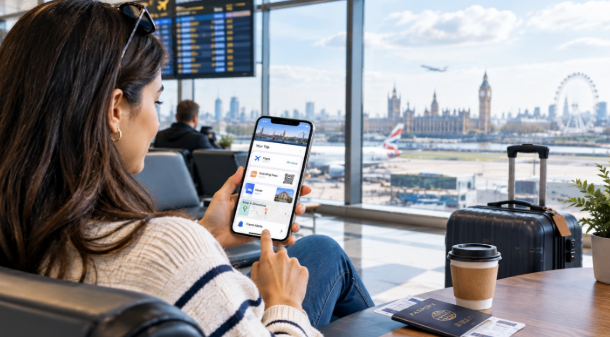
Travelling can be one of the most exciting experiences in life, but planning a trip is not always simple. Flights, hotels, transport, restaurant bookings, attraction tickets, travel documents, maps, and changing schedules can quickly become difficult to manage.
For UK travellers, smartphones have become an important part of that process. People use their devices to research destinations, compare prices, manage bookings, navigate unfamiliar places, and stay connected while abroad. A well-designed travel application can bring many of these activities together in one convenient experience.
This is where travel app development services can make a difference. Instead of forcing travellers to switch between several websites and applications, businesses can create digital experiences that help users plan, book, manage, and enjoy their journeys from one place.
The opportunity is significant. ABTA’s Holiday Habits 2025-26 research found that 87% of UK adults had taken a holiday during the previous 12 months, while 59% had travelled abroad. The same research showed that 65% considered holidays the most important time of the year.
With so many people prioritising travel, businesses have an opportunity to use technology to make every stage of the journey easier.
Table of Contents
- Why Better Travel Experiences Matter
- Simplifying Trip Planning
- Creating Personalised Travel Recommendations
- Making Bookings Faster and Easier
- Providing Real-Time Travel Updates
- Supporting Travellers With Navigation and Maps
- Helping Users Discover Authentic Experiences
- Improving Communication During Travel Disruptions
- Designing for Families, Solo Travellers, and Different Needs
- Data, Insights, and Statistics
- Final Thoughts
- Frequently Asked Questions
Why Better Travel Experiences Matter
Travel customers do not judge an experience only by the destination.
They also remember how easy it was to organise the journey.
Was the booking process straightforward? Could they find their boarding pass quickly? Did they receive updates when something changed? Could they find directions without switching applications?
Each small interaction can influence satisfaction.
ABTA’s 2025-26 research found that 34% of respondents had used a travel professional to book a holiday during the previous 12 months. Among those users, 57% cited ease of booking as the most common reason, followed by saving time at 42%.
The message is clear: convenience matters.
A travel app should therefore remove friction rather than add another layer of complexity.
Simplifying Trip Planning
Travel planning often starts weeks or months before departure.
Users may browse destinations, compare accommodation, check flight schedules, calculate travel times, and create daily plans. They may save dozens of links or switch between several applications.
A smart travel app can bring these tasks together.
Users could enter their destination and travel dates, then access flights, hotels, activities, transportation information, and itinerary options from a central dashboard.
An organised itinerary can also display everything in chronological order.
For example:
08:00 – Hotel check-out
09:00 – Airport transfer
11:30 – Flight departure
15:10 – Hotel check-in
18:00 – Restaurant reservation
This simple structure can turn a complicated trip into a manageable schedule.
Creating Personalised Travel Recommendations
Not every traveller wants the same holiday.
A young couple might prefer nightlife, local restaurants, and cultural events. A family may prioritise child-friendly attractions and shorter travel times. A solo traveller might look for affordable activities, social experiences, or quieter destinations.
Personalisation can help travel applications respond to these different preferences.
The app can learn from saved destinations, previous bookings, preferred budgets, interests, and search behaviour. It can then recommend hotels, attractions, restaurants, or activities that are more relevant to the individual.
This becomes particularly useful as travellers increasingly look beyond traditional tourist experiences.
ABTA reported that 45% of people intending to take an overseas holiday in 2025 said they were likely to visit a country they had not visited before. The organisation also highlighted growing interest in more authentic local experiences.
A personalised application can help users discover these experiences without overwhelming them with endless options.
Making Bookings Faster and Easier
A poor booking experience can cause users to abandon their plans.
Forms that are too long, unclear pricing, limited payment choices, or confusing navigation can create unnecessary friction.
Travel applications can simplify the process by allowing users to search, compare, select, and pay within an intuitive interface.
A strong booking experience should make important details obvious.
Users should be able to see:
- Total cost
- Cancellation policies
- Available dates
- Booking confirmation
- Payment status
- Contact information
- Important travel conditions
Digital wallets and secure payment options can further reduce unnecessary steps.
The objective is simple: help travellers complete a booking with confidence rather than making them work to understand it.
Providing Real-Time Travel Updates
Travel rarely goes exactly according to plan.
Flights can be delayed. Gates can change. Trains may be cancelled. Weather can affect road conditions. Hotel arrangements may need adjustment.
Real-time notifications can help travellers respond quickly.
A travel application can deliver alerts for:
Flight delays
Gate changes
Boarding reminders
Weather conditions
Transfer times
Booking changes
This functionality is especially valuable when travellers are moving between unfamiliar locations.
Instead of repeatedly checking different services, users can receive important updates through a central platform.
Supporting Travellers With Navigation and Maps
Navigation becomes essential once a traveller reaches an unfamiliar destination.
An effective travel application can integrate interactive maps, hotel locations, transport routes, attraction points, restaurant recommendations, and walking directions.
Offline functionality can make this even more useful.
Travellers may not always have reliable mobile data when abroad. An app that allows users to save maps, booking details, Instasupersave, and essential directions for offline use can provide additional reassurance.
Location-based features can also deliver relevant suggestions nearby.
For example, a traveller arriving at a hotel could receive information about restaurants, pharmacies, attractions, or public transport within walking distance.
Helping Users Discover Authentic Experiences
Modern travellers increasingly look for experiences rather than simply ticking famous attractions off a checklist.
A travel app can highlight independent restaurants, local markets, cultural events, outdoor activities, museums, neighbourhoods, and experiences that match the user’s interests.
This can also help smaller tourism businesses gain visibility.
Instead of promoting only major hotels and attractions, a well-designed platform can create space for local providers and independent businesses.
ABTA’s research has highlighted continued interest in unique activities and deeper destination experiences, suggesting that travellers want more than a standard itinerary.
Improving Communication During Travel Disruptions
Even the best itinerary cannot prevent unexpected problems.
What matters is how quickly the traveller can find help.
A travel app can provide central access to customer support, booking information, emergency contacts, refund procedures, and alternative options.
For example, if a transfer is cancelled, the app could display the updated arrangement and provide a clear way to contact support.
This is where technology becomes more than a convenience. It can become a source of reassurance.
ABTA found that 41% of people said they felt more confident having booked through a travel professional, up from 36% the previous year.
A digital platform cannot replace human support in every situation, but it can make important information easier to access when travellers need it most.
Designing for Families, Solo Travellers, and Different Needs
Travel applications should not assume everyone travels in the same way.
Families may need connected bookings, child-friendly recommendations, and reminders for multiple people. Solo travellers may value safety features and local support. Older users may benefit from larger text, simpler navigation, and clear instructions.
Accessibility should therefore be considered during the design process.
Features such as readable typography, voice support, strong colour contrast, straightforward navigation, and screen-reader compatibility can improve the experience for a broader audience.
A simple interface often benefits everyone, not only users with accessibility requirements.
Data, Insights, and Statistics
The wider UK digital environment supports the case for mobile-first travel experiences.
Ofcom reported in Online Nation 2025 that UK adults spent an average of 4.5 hours online each day, with most online time taking place on smartphones. Adults used an average of 41 apps per month in 2025.
That means travel applications are entering an environment where users are already comfortable managing everyday activities through their phones.
There is also evidence that technology is influencing how people discover holidays.
ABTA reported that the proportion of people using AI for holiday inspiration doubled from 4% to 8% in 2025. Among 25–34-year-olds, usage reached 18%. Traditional internet searches remained much more common at 48%, while recommendations from friends and family reached 41%.
These figures suggest that travel technology is evolving beyond simple booking systems.
Future-focused apps can combine search, recommendations, personalisation, itinerary management, maps, notifications, and support into one connected journey.
Final Thoughts
The best travel applications do not simply provide more information.
They make travel easier.
From the first destination search to the final journey home, technology can remove unnecessary steps, provide timely information, personalise recommendations, and give travellers greater confidence.
For UK travel businesses, this creates an opportunity to build stronger relationships with customers while improving convenience at every stage of the journey.
The key is thoughtful development. An effective travel app should be based on real traveller needs rather than a long list of fashionable features.
When planning, booking, navigation, communication, and support work together, a travel application can become a trusted companion instead of just another icon on a smartphone.
Frequently Asked Questions
What features should a modern travel app include?
Important features can include trip planning, bookings, secure payments, digital itineraries, maps, push notifications, personalised recommendations, reviews, customer support, and offline access to important information.
How can a travel app improve the booking experience?
It can bring search, comparison, payment, confirmation, and booking management into one streamlined process. This reduces the need to switch between multiple platforms.
Can travel apps provide real-time flight information?
Yes. Travel applications can integrate flight and transport data to provide updates about delays, cancellations, gates, boarding times, or schedule changes.
Why is personalisation important in travel apps?
Travellers have different budgets, interests, ages, and travel styles. Personalised recommendations can help users find destinations, accommodation, restaurants, and activities that are more relevant to them.
Are offline features useful for travellers?
Yes. Offline maps, saved bookings, travel documents, and essential destination information can be particularly helpful when users have limited mobile connectivity.
Can AI be used in travel applications?
Yes. AI can support features such as personalised recommendations, itinerary generation, conversational travel assistance, destination discovery, and customer support. Its usefulness depends on how accurately and responsibly it is implemented.
How can travel apps help during emergencies or disruptions?
They can provide alerts, customer-support access, alternative booking information, emergency contacts, and updated travel instructions. Clear communication can be especially valuable when plans change unexpectedly.