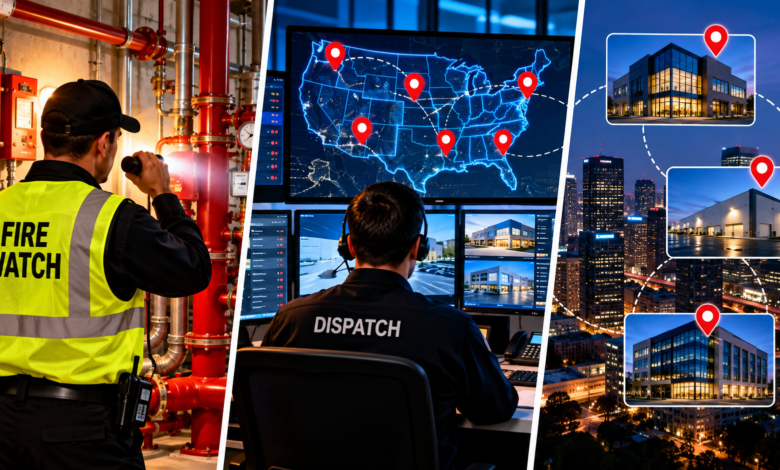
NPP systems provide a solution to an existing problem: a blackout may happen in one building, one town, or even in a number of buildings simultaneously. Successful implementation of such services presupposes coordination between response capabilities, dispatch, written procedures, and escalation in case there is any problem with fire alarms, sprinklers, suppression systems, or power.
Multi-site business owners are faced with more than just looking for a guard. A nationwide fire watch model must coordinate regional personnel, verify site conditions, adapt patrol instructions to each property, and maintain records authorities can review. The process works best as a controlled handoff from detection to deployment, mitigation, monitoring, and restoration.
Central Dispatch Model
Central dispatch receives outage details, confirms the start time, then routes the assignment. That matters during regional disruptions. If several properties lose protection simultaneously, dispatch can prioritize occupied buildings and higher-hazard sites.
Regional Coverage Logic
A practical model uses distributed personnel with centralized scheduling. Before deployment, confirm:
- Address and affected system
- Areas requiring patrol
- Occupancy status
- Reporting frequency and contacts
- Restoration ETA
NFPA materials distinguish planned and emergency impairments and emphasize minimizing impairment duration.
Planned Versus Emergency
| Factor | Planned outage | On-demand outage |
|---|---|---|
| Trigger | Maintenance or testing | Failure or damage |
| Preparation | Scheduled beforehand | Starts after notification |
| Site briefing | Usually prepared | Gathered during intake |
| Main challenge | Continuity | Speed and triage |
The assignment should include a post order, patrol route, emergency contacts, and a procedure for reporting hazards.
Documentation Across Sites
Consistent records matter when portfolios span jurisdictions. Standardized timestamps, observations, incidents, notifications, and handoffs create a usable record while local rules control the assignment.
USFA guidance notes that fire watch may be established when a fire protection system cannot be repaired or restored promptly. OSHA likewise requires effective fire protection and prevention programs on construction sites and additional personnel for some hot-work situations.
What Networks Should Measure
Measures are operational:
- Notification-to-dispatch confirmation
- Assignment-to-arrival time
- Shift-change coverage continuity
- Patrol-log completion
- Hazard escalation time
- Restoration and closeout time
These measures reveal weak links hidden by coverage claims. For portfolio operators evaluating nationwide fire watch, the key question is whether one network can preserve local accountability while coordinating multiple outages consistently.
Reliable Handoffs
A resilient property protection network is less about having a geographic footprint than about making each handoff consistent. The strongest operating model connects centralized coordination with people who understand local property hazards and authority expectations.
That means an outage is never treated as a dispatch event. It becomes a managed sequence: identify the impairment, establish mitigation, maintain disciplined field coverage, document what happened, and confirm restoration before closing the assignment.
For property portfolios, that consistency is what turns scattered emergency responses into a repeatable protection process overall.
FAQs
1. What happens when multiple properties lose fire protection at the same time?
A national network can coordinate simultaneous assignments through centralized dispatch while using personnel in different regions. Each property should receive site-specific instructions based on its hazards, occupancy, affected systems, and local requirements.
2. How quickly can fire watch coverage be arranged during an unexpected outage?
Response time depends on location, personnel availability, outage severity, and assignment requirements. An effective network first confirms the impairment and site details before dispatching appropriate personnel rather than treating every request identically.
3. Who determines how long fire watch must remain in place?
The duration depends on the circumstances of the impairment and applicable requirements. The responsible property team should coordinate with the fire protection provider, insurer, and applicable authority having jurisdiction (AHJ) when determining when normal protection can resume.
4. How is fire watch coordinated across different states?
Coordination typically combines centralized scheduling with local personnel and site-specific procedures. Because fire and building requirements can differ between jurisdictions, national coordination does not eliminate the need to account for local AHJ requirements.
5. What is required to be documented during a fire-watch outage?
The details that should be included are the nature of the problem, when it occurred, the people involved in dealing with the problem, the patrols that have been done, the hazards identified, any incident that has occurred, the notification, the measures that have been taken, and the restoration of the protection.