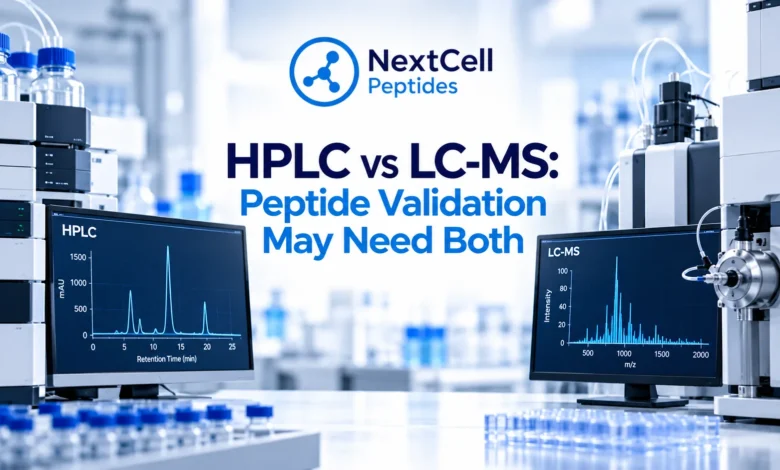
Peptide research depends on accurate analytical testing. Researchers need to establish whether a sample has the expected molecular characteristics, identify additional components and understand how its composition compares with the relevant specifications.
Two important techniques used in this process are high-performance liquid chromatography (HPLC) and liquid chromatography-mass spectrometry (LC-MS). Although both involve chromatography, they provide different types of analytical information.
HPLC is commonly used to examine sample separation and chromatographic purity, while LC-MS combines separation with molecular mass analysis. Understanding how these techniques work helps researchers interpret testing reports and recognise the limitations of individual results.
What Is HPLC in Peptide Research?
High-performance liquid chromatography is an analytical method used to separate different components within a sample.
A prepared sample passes through a column containing a stationary phase. A liquid mobile phase carries the sample through the column, and individual compounds interact differently with the stationary phase.
These differences influence how quickly components move through the system, producing a chromatogram that researchers can examine.
How HPLC Separates Peptides
Peptides have different chemical and physical properties. Their amino acid sequences, molecular characteristics and modifications can influence their chromatographic behaviour.
Depending on the method, researchers can examine:
- Retention times of detected components.
- The number and distribution of chromatographic peaks.
- Relative peak areas.
- Differences between sample batches.
- Signals that may require further investigation.
The selected column, mobile phase and detection conditions all influence the resulting chromatogram. Consequently, the analytical method must be suitable for the particular peptide being investigated.
Understanding HPLC Purity Results
HPLC is frequently used to assess chromatographic purity.
A dominant peak may indicate that one component accounts for most of the detected chromatographic signal. Smaller peaks may represent impurities, related compounds or other sample components.
However, an HPLC purity percentage should not be interpreted as a complete measure of sample quality.
The result depends on the analytical conditions and detection method. Some components may not be detected effectively, while compounds with similar chromatographic behaviour may produce overlapping signals.
HPLC therefore provides useful information about sample composition, but it does not independently establish every aspect of molecular identity.
What Is LC-MS in Peptide Analysis?
Liquid chromatography-mass spectrometry combines two analytical techniques.
The liquid chromatography stage separates the sample components, while the mass spectrometer measures the mass-to-charge ratios of detected ions.
This provides researchers with information about both chromatographic separation and molecular characteristics.
How LC-MS Works
During LC-MS analysis, the prepared sample first passes through a chromatographic column.
As individual components leave the column, they enter the mass spectrometer, where they are converted into detectable ions. The instrument records their mass-to-charge information.
Researchers can then compare the results with the expected molecular characteristics of the compounds under investigation.
Why Molecular Mass Matters
Molecular mass is an important reference point when investigating peptide identity.
Researchers compare measured mass information with the expected specification of the peptide. Differences may indicate modifications, related compounds or other characteristics requiring further investigation.
However, a matching molecular mass does not necessarily prove the complete amino acid sequence. Additional structural information may be necessary to establish a stronger identity assessment.
HPLC vs LC-MS: Main Differences
Both techniques have important roles in peptide analysis, but their outputs and applications differ.
| Feature | HPLC | LC-MS |
| Primary function | Separates sample components | Separates and analyses molecular mass |
| Main output | Chromatogram | Chromatographic and mass-analysis data |
| Common application | Purity and separation assessment | Molecular mass and identity investigation |
| Main limitation | Does not independently confirm complete molecular identity | Mass information alone may not establish the complete sequence |
| Analytical focus | Sample separation | Separation plus molecular information |
Neither technique is universally superior. The appropriate method depends on the compound, the research question and the information required.
The Role of Tandem Mass Spectrometry
Some peptide investigations require more structural information than an intact mass measurement can provide.
Tandem mass spectrometry, commonly called MS/MS, helps address this requirement by fragmenting selected ions and analysing the resulting fragments.
The fragmentation patterns can provide additional information about amino acid sequence characteristics and help distinguish between related molecular structures.
This can be particularly useful when investigating modified peptides or compounds with similar molecular masses.
However, MS/MS results also require appropriate reference information and careful interpretation. The method provides additional structural evidence rather than an automatic guarantee of complete identification.
Why Different Peptides Require Different Testing Approaches
Not all peptides behave identically during laboratory analysis. Molecular size, amino acid sequence, chemical modifications and other characteristics can influence chromatographic separation and mass-spectrometry results.
Retatrutide, for example, is a modified 39-amino-acid peptide with a lipid-linked side chain. These structural characteristics need to be considered when selecting analytical methods and interpreting results.
Multi-component formulations introduce a different analytical challenge. A blend containing BPC-157 and TB-500 includes two separate peptide-related components, each with its own expected molecular characteristics.
Researchers looking for a Wolverine Blend from Research Peptides UK. When examining this type of formulation, the identity and analytical characteristics of both listed ingredients should be considered separately.
Common Mistakes When Reading Peptide Testing Reports
Analytical reports can be misleading when researchers overlook the limitations of the methods used.
Confusing purity with identity: A high HPLC purity result does not automatically confirm the complete molecular structure.
Assuming matching mass proves sequence: Mass measurements support identification but may not distinguish every structural variation.
Ignoring analytical conditions: Results should be interpreted according to the specific method, detection settings and sample characteristics.
Applying one result to an entire blend: Evidence relating to one component does not automatically establish the identity of every ingredient.
Overlooking batch information: Testing documentation should relate to the material being evaluated.
Understanding these limitations helps researchers distinguish actual analytical findings from assumptions.
What Should a Peptide Testing Report Include?
A useful analytical report should explain what was tested and how the findings were obtained.
Researchers should look for:
- Clear identification of the analysed material.
- Batch or sample reference information.
- The analytical method used.
- Relevant chromatographic or mass-analysis results.
- Appropriate reference information.
- Testing dates and relevant laboratory details.
Where HPLC and mass spectrometry results are both available, researchers should examine what each method demonstrates rather than treating them as interchangeable.
Frequently Asked Questions
Is HPLC the same as LC-MS?
No. HPLC separates sample components, while LC-MS combines chromatographic separation with mass spectrometry to provide additional molecular information.
Can HPLC confirm peptide purity?
HPLC can provide a chromatographic purity assessment under the selected method. Its findings must be interpreted according to the method’s sensitivity and limitations.
Does LC-MS confirm the complete peptide sequence?
Not necessarily. LC-MS provides molecular mass information, while tandem mass spectrometry can provide additional structural information.
Which method is better for peptide research?
Neither is universally better. HPLC is useful for chromatographic separation, while LC-MS adds molecular information that can support identity assessment.
Final Thoughts
HPLC and LC-MS provide complementary information in peptide research. HPLC helps researchers examine sample separation and chromatographic purity, while LC-MS adds molecular mass information that can support compound identification.
Understanding their differences makes it easier to interpret analytical reports, assess peptide specifications and recognise where additional testing may be necessary.
Researchers interested in this individual research compound can Buy Retatrutide GLP-3 from UK Peptide and review its product specifications when comparing peptide research materials.
The most reliable approach is to evaluate each result according to the analytical method used, the peptide being examined and the limitations of the available evidence.