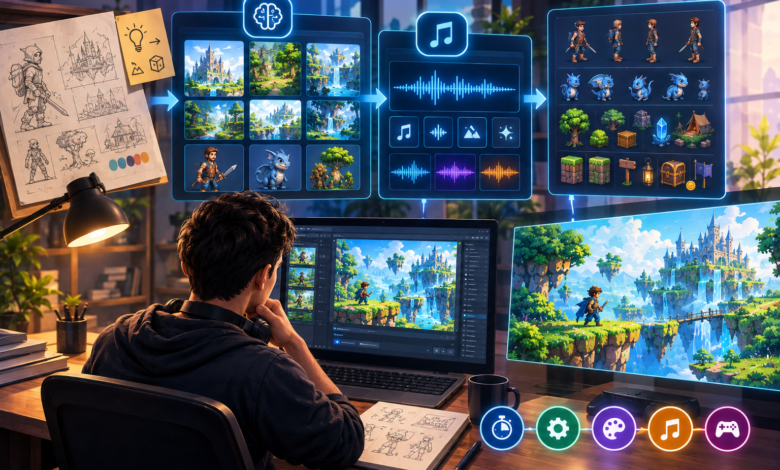
Asset creation has always been the silent killer of game projects, especially for solo developers and small teams without dedicated artists. A strong core mechanic can sit abandoned for months waiting on visual polish that never materializes, or a team spends so much time on art that the actual gameplay never gets properly tested. AI game makers have started addressing this bottleneck by handling asset generation dirctly, removing one of the biggest friction points that used to separate people with great ideas from people with finished games.
The Asset Creation Problem That Slowed Everything Down
Why Assets Became the Bottleneck
Game development involves several skill sets: design, programming, art, audio. For solo creators and small teams, having someone excellent at design doesn’t mean you have someone capable of producing polished visual assets. Waiting for art to materialize often means watching a project stall while the core gameplay sits incomplete, testing half-finished with placeholder assets that don’t communicate the game’s intent clearly.
The Hidden Cost of Manual Asset Production
A single visual asset that might take a professional artist an hour to produce could represent significant delay for a solo developer who’s never done character design or environmental art. Audio is similarly demanding, a short music loop that sets the tone for a game requires either musical skill or the resources to hire someone who has it. These aren’t optional luxuries, they directly impact whether a game feels polished or rough.
The Catch-22 of Validation
You can’t validate whether a game’s core mechanic works without visual and audio context. Players judge games holistically, and rough or missing assets undermine confidence in an otherwise solid concept. But committing to professional asset production before confirming the core mechanic is sound feels like wasted investment. This catch-22 used to trap a lot of promising ideas.
How AI-Assisted Asset Generation Changes the Equation
Generating Usable Assets Automatically
AI game makers now generate visual and audio assets alongside the mechanics, removing the requirement to commission or manually create placeholder content before testing. A generated sprite, background, or sound effect might not be museum-quality, but it’s often usable enough to communicate the game’s intent and let authentic playtesting happen.
Removing the Art Specialist Requirement
Because asset generation is built into the platform, solo developers and non-artists can produce visually complete prototypes without needing to hire an artist or spend months learning art skills. This democratizes what becomes possible for creators without traditional art backgrounds.
Freeing Time for Iteration Instead of Asset Production
Every hour that doesn’t go toward manual asset creation becomes available for actual game refinement. That time reallocation, from production overhead to design iteration, directly improves the quality of the finished game.
Compressing the Timeline From Concept to Playable
A project that used to take weeks or months to reach a visually complete playable state can now reach that milestone in days or even hours, dramatically changing what’s realistic within any given project timeline.
What AI-Generated Assets Actually Look Like
Visual Quality Varies With Platform and Concept
The quality of generated visuals depends on the platform’s training data and the specificity of the description provided. Abstract, simple aesthetics often look great. Complex, highly detailed visuals sometimes look rough or uncanny. Understanding the platform’s visual strengths matters for matching your concept to what it can produce well.
Audio Assets Range From Usable to Genuinely Good
Generated sound effects and music vary widely. Simple, percussive effects often work well. Complex orchestral music sometimes sounds synthetic and recognizable as AI-generated. Knowing the limits of what a platform generates well prevents committing to an aesthetic it can’t actually deliver.
Customization Bridges the Gap Between Generated and Bespoke
Most platforms that generate assets also let you customize or tweak them, adjusting colors, proportions, or parameters to better match your vision. That flexibility between “fully generated” and “fully customized” lets creators find their own balance between speed and specificity.
Placeholder Quality Matters More Than Final Quality
For early testing and validation, the distinction between “professionally polished” and “clearly communicates the intent” is far less important than most creators assume. Generated assets that are 70% as good as hand-crafted ones are often good enough to validate a concept and make real design decisions.
How Asset Generation Specifically Helps Different Creator Types
Solo Developers Get Access to Multimedia Production
Without asset generation, a solo developer had to choose: spend all their time on gameplay and ship something visually rough, or spend half their time learning art skills that could substitute for hiring. Asset generation removes that choice entirely.
Small Teams Can Redistribute Their Time
A three-person team can now spend less time on asset production and more time on game design, playtesting, and polish. That reallocation is what actually determines whether a small team ships something good.
Non-Artists With Great Ideas Get a Real Path Forward
People with strong game design instincts but no art background could previously only express those instincts by either hiring artists or learning entirely new skills. Generated assets remove that barrier completely.
Rapid Prototyping Becomes Actually Realistic
AI games built with asset generation can go from concept to testable prototype in a single session. That speed enables genuine experimentation that slower, manual asset production never could support.
What Assets Still Benefit From Manual Work
Distinctive Visual Branding
If a game’s visual style is central to its identity, custom art that reflects that specific vision matters more than generated assets ever could. Games like Snake Rush 3D show how a clean, distinctive visual aesthetic contributes to the overall experience, exactly the kind of visual coherence that can come from manual curation or custom asset work.
Highly Specialized Technical Assets
Physics simulations, complex particle effects, or other technically demanding visuals sometimes benefit from specialized work that asset generation doesn’t handle as well. For most games, this doesn’t matter. For the specific ones where it does, manual work remains valuable.
Memorable Audio Branding
A distinctive soundtrack or sound design that becomes synonymous with a game requires musical sensibility that asset generation can support but rarely fully replaces. Games with memorable audio typically had someone with genuine musical taste making deliberate choices.
Culturally Specific or Historically Accurate Assets
Generated assets work well for generic fantasy or sci-fi aesthetics. For games requiring authentic cultural representation or historical accuracy, human creativity and research matter considerably.
Using Generated Assets Strategically
Generate First, Customize Later if Needed
Start with generated assets, test the game with them, and only then invest in custom work if the concept validates and a distinctive visual style becomes strategically important. This approach captures the speed advantage while preserving the option to upgrade visuals later.
Mix Generated and Custom Assets
Not every asset needs to be custom or generated uniformly. A game might use generated backgrounds with custom characters, or generated character sprites with custom animations. That mixing lets creators focus custom effort where it matters most.
Use Generation for Iteration, Custom Work for Final Polish
During prototyping and iteration, generated assets keep pace with design changes. Once the core is confirmed and design is locked, custom work on the final visual presentation often makes sense as a finishing layer.
Recognize Platform Aesthetic Limits and Design Toward Them
Every asset generation platform has an aesthetic it produces well and edges cases it struggles with. Designing games that work within those constraints rather than fighting them produces better results with less custom work.
Common Misconceptions About AI-Generated Assets
“AI Assets Look Visibly Generated”
This was true for early platforms. Modern systems produce assets that look intentional and cohesive, even if they’re not individually masterpieces. Context matters enormously, a generated sprite looks far better as part of a complete game than in isolation.
“Generated Assets Are Only Good for Prototypes”
Plenty of shipped games use primarily or entirely generated assets successfully. The constraint isn’t technical, it’s whether the aesthetic and quality level suit the game’s intent and audience.
“Custom Art Is Always Better Than Generated”
Custom art by a skilled artist is better than generated assets. Custom art by someone still learning is often worse than good generated assets. The comparison depends on actual available talent, not abstract preferences.
“Using Generated Assets Is Somehow Less Legitimate”
This assumption doesn’t hold up. What matters is the finished game’s quality and whether players enjoy it, not the production method behind the assets. A generated asset that works is a solved problem, not a compromise.
Final Thoughts
AI game makers simplify asset creation by removing the requirement to personally produce or commission every visual and audio element before a game can be tested and validated. This doesn’t mean generated assets are always final-quality or eliminate the value of skilled artists, it means the barrier to getting a complete, testable game in front of real players has dropped dramatically.
For solo developers and small teams, this shift is genuinely transformative. The time and energy that previously went to asset production can now go toward the design decisions and iteration that actually determine whether a game is good. That reallocation is what creates space for more people to build games worth playing, regardless of their art skills or budget for hiring specialists.